
Awakening sounds like something reserved for saints — not for ordinary people. But the Buddha did not describe awakening as a miracle. He described it as the result of a process — a process that can be mapped, learned, and practiced.
That process involves seven qualities. The Buddha called them the Seven Factors of Awakening (Bojjhaṅga) — seven qualities that, when fully developed, lead to complete liberation.
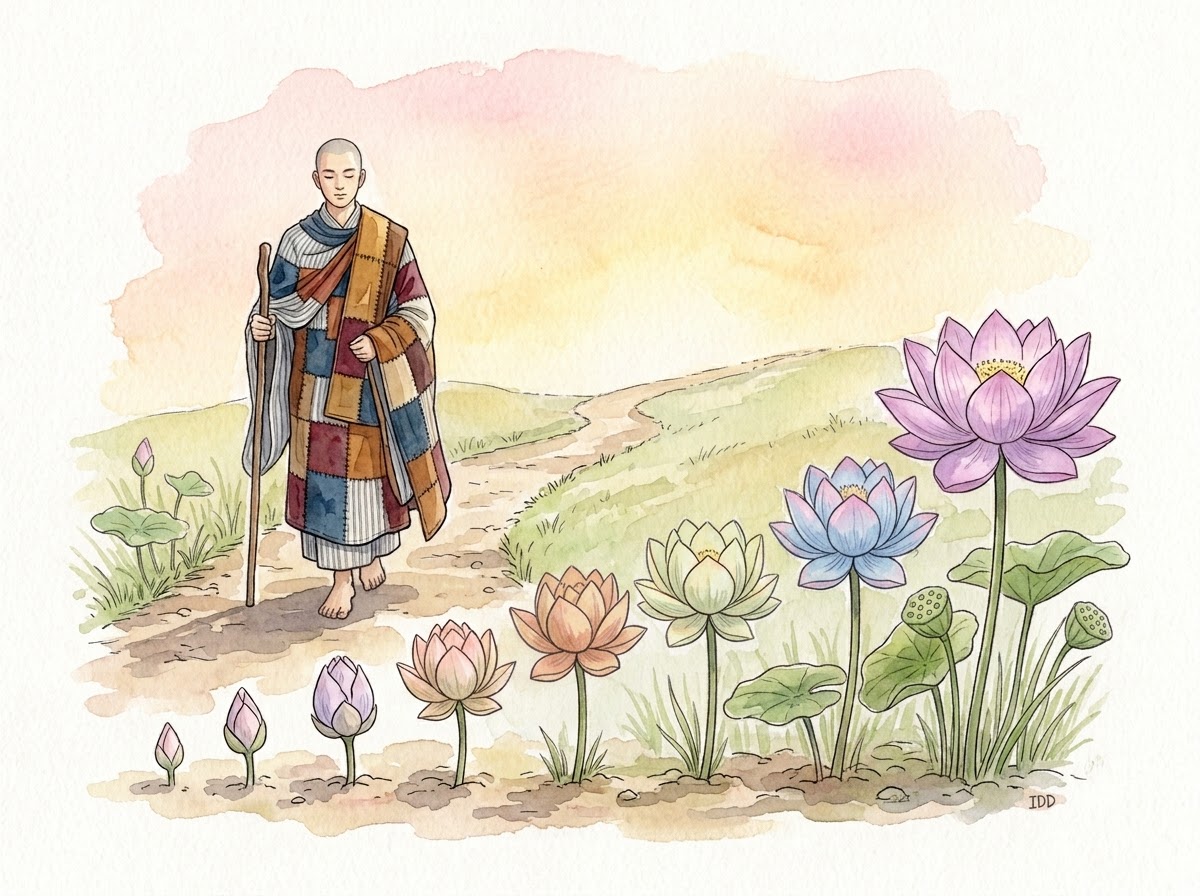
What Are the Seven Factors?
1. Mindfulness (Sati-sambojjhaṅga) — Clear awareness of what is happening in body and mind at each moment. Mindfulness is the foundation — without it, the other six cannot develop.
2. Investigation of phenomena (Dhammavicaya-sambojjhaṅga) — The ability to look directly into the nature of what is occurring: this is impermanent, this is suffering, this is non-self. Wisdom in action — seeing and understanding, not thinking and guessing.
3. Energy (Vīriya-sambojjhaṅga) — Effort, vigor. Not straining, but sustaining steady energy in practice: neither too tense nor too slack.
4. Joy (Pīti-sambojjhaṅga) — Rapture, delight in practice. When practice is on the right track, a natural joy arises — a sign that the path is correct.
5. Tranquility (Passaddhi-sambojjhaṅga) — Calm stillness of body and mind. When joy settles, it gives way to a deeper peace.
6. Concentration (Samādhi-sambojjhaṅga) — Focused, settled attention. The mind becomes stable, unshaken, fully present.
7. Equanimity (Upekkhā-sambojjhaṅga) — Balance, letting go. The mind does not lean either way. Equanimity is the highest of the seven factors: when the mind is perfectly balanced, awakening becomes possible.
The Natural Sequence
The seven factors form a natural developmental sequence:
Mindfulness → investigation → energy → joy → tranquility → concentration → equanimity.
Each factor is the condition for the next. Skip one step, and the sequence is broken. But no forcing is needed — when the preceding factor is mature enough, the next arises naturally.
Balancing Two Groups
Active group: Investigation, Energy, Joy — these carry vigor, stimulation, forward momentum.
Calming group: Tranquility, Concentration, Equanimity — these carry stillness, stability, settledness.
Mindfulness stands in the middle, serving as monitor and balancer.
When the mind is sluggish — develop the active group. When the mind is restless — develop the calming group. Knowing how to adjust between the two based on the mind’s actual state — that is wisdom in practice.

Thầy Minh Tuệ — The Seven Factors on the Walking Path
Mindfulness: Each step is a step of awareness. He walks without music, without idle conversation, without distraction from devices.
Investigation: He does not merely walk — he observes. Observing body, observing mind, observing impermanence in each moment. The road is his meditation hall.
Energy: Over a decade without stopping. The energy of practice maintained steadily, day after day.
Joy: Those who meet him often speak of the serenity on his face — the natural contentment of a mind in a wholesome state.
Tranquility: Amid noisy crowds, amid controversy, he maintains inner stillness.
Concentration: The consistency of his journey — the same lifestyle, the same direction, unshaken by any circumstance.
Equanimity: Praise does not make him happier, criticism does not make him sadder. When offered food, he accepts; when not, he continues. No grasping, no pushing away — balance.

The Seven Factors in the Suttas
In the Saṃyutta Nikāya (SN 46.2), the Buddha explained that the seven factors do not develop randomly — each has specific nutriment that feeds its growth.
For example: the nutriment of mindfulness is wise attention — deliberately directing awareness to what is happening. The nutriment of investigation is learning and reflection — not just meditation, but also hearing the Dhamma, reading the suttas, and contemplating impermanence.
The Buddha also taught in the Mahāsatipaṭṭhāna Sutta (DN 22) that the seven factors develop through the Four Foundations of Mindfulness — observing body, feeling, mind, and phenomena. This is a practical path, not abstract theory.
Common Mistakes in Developing the Seven Factors
Forcing the sequence: Some practitioners try to force the seven factors into strict order. In reality, they develop in an interleaving pattern. Sometimes concentration comes before joy; sometimes energy needs to be redeveloped midway. The key is recognizing which factor is lacking.
Overemphasizing one group: Active personalities tend to over-develop investigation–energy–joy, leading to restlessness. Contemplative personalities tend to over-develop tranquility–concentration–equanimity, leading to dullness. Balancing both groups — with mindfulness in the center — is essential.
Confusing joy with excitement: Joy in the context of the awakening factors is a quiet, pure happiness arising from correct practice — not agitation or thrill. If your “joy” leaves the mind unsettled, it is not the joy of the awakening factors.
Neglecting equanimity: Equanimity is often overlooked because it is the subtlest factor. But without it, the other six remain incomplete. Equanimity is the crown — the quality that transforms all the others into a unified, balanced state ready for awakening.
Practicing the Seven Factors in Everyday Life
Mindfulness: Spend five minutes each day fully present — washing dishes and knowing you are washing dishes.
Investigation: When facing difficulty, pause and observe: this is impermanent, this will pass.
Energy: Maintain daily practice, even just five minutes. Consistency matters more than duration.
Joy: When you notice yourself living more mindfully, allow yourself to appreciate it.
Tranquility: When stressed, relax your shoulders, breathe deeply, let body and mind settle.
Concentration: Focus completely on one thing at a time — stop multitasking.
Equanimity: When results disappoint, remind yourself: “This is outside my control, and that is okay.”
The seven factors are not a distant destination. They are qualities that can be cultivated every day — and each bit of development brings the mind closer to wakefulness.
The Seven Factors and the Path to Liberation
The seven factors of awakening hold a special place in the Buddha’s teachings. While the Noble Eightfold Path describes the overall direction of practice, and the Four Right Efforts provide the energy, the seven factors describe what the mind actually looks like as it approaches awakening.
The Buddha said that when all seven factors are fully developed, one of three results follows: full awakening in this very life, or — if residual attachment remains — awakening at the moment of death, or awakening shortly after rebirth in a favorable realm.
This teaching carries an important message: awakening is not random or mysterious. It is the natural outcome of developing specific, identifiable mental qualities. Anyone who cultivates these seven qualities fully will reach liberation — this is the Buddha’s promise, and it applies to all beings without exception.
The seven factors are not something you achieve once and keep forever. They need continuous cultivation. Even experienced practitioners go through periods where some factors weaken and need to be re-strengthened. The practice is ongoing — and that is perfectly natural.
In the Saṃyutta Nikāya (SN 46.14), the Buddha also described the seven factors as a remedy for illness. When the monk Mahā Kassapa was sick, the Buddha recited the seven factors, and Kassapa recovered. Whether understood literally or as a teaching about the healing power of a balanced mind, this story reflects the deep connection between mental development and well-being.
The seven factors of awakening are, in essence, the portrait of a mind in its healthiest, most luminous state — alert yet calm, joyful yet balanced, engaged yet free. They describe not just what awakening looks like, but what a human mind is capable of when properly trained.
Frequently Asked Questions
What are the Seven Factors of Awakening?
The Seven Factors (Bojjhaṅga) are mindfulness, investigation of phenomena, energy, joy, tranquility, concentration, and equanimity. They form a natural developmental sequence that leads to liberation.
In what order should the Seven Factors be developed?
They develop naturally in sequence: mindfulness leads to investigation, which arouses energy, giving rise to joy, settling into tranquility, deepening into concentration, and culminating in equanimity.
How do I balance the Seven Factors?
When the mind is sluggish, strengthen the active factors (investigation, energy, joy). When the mind is restless, strengthen the calming factors (tranquility, concentration, equanimity). Mindfulness stands in the middle, monitoring which group needs attention.
Can I practice the Seven Factors without formal meditation?
Yes. Each factor can be cultivated in daily life: mindfulness while washing dishes, investigation when facing difficulty, energy through consistent daily practice, joy from appreciating wholesome moments, tranquility through deep breathing, concentration by doing one thing at a time, and equanimity by accepting what is outside your control.
What is the difference between joy (pīti) and tranquility (passaddhi)?
Joy is the initial delight and enthusiasm that arises when practice is going well — it carries energy and uplift. Tranquility is what remains when that initial excitement settles into a deeper, quieter peace. Joy is like the excitement of reaching a beautiful mountaintop; tranquility is the stillness of sitting there, fully at rest.
How do the Seven Factors relate to the Four Right Efforts?
The Four Right Efforts provide the energy and direction for practice, while the Seven Factors describe the qualities that develop as a result. Right Effort fuels the entire process — without it, the seven factors cannot mature. Together they form complementary aspects of the 37 Aids to Awakening.