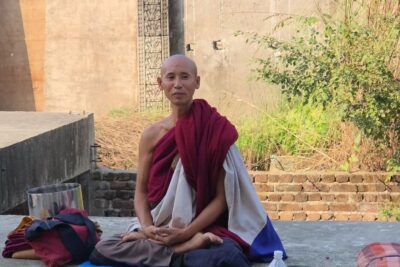

The two guardian deities holding swords at the temple gate inspire a thought: sometimes, do we need to use force to defend ourselves? This question was raised with Master Minh Tue in Nepal on February 19, 2026. His answer does not rely on theory — he cites directly a verse from the Dhammapada that the Buddha taught over 2,500 years ago.
Buddhist disciple asks: I see in the temple there are two guardian deities holding swords to exorcise demons. Should worldly people use strong measures when pushed beyond their limits, Master? (February 19, 2026 – Nepal)
Master Minh Tue answers:
The most optimal measure is to resolve it with compassion. The Buddha taught that hatred can never extinguish hatred. For example, if you sit here with a sword ready, the person approaching will bring a stronger sword or gun. But if you have nothing, they won’t prepare a sword for no reason.
If an honest person has no weapons and you use authority to harm them, you are harming yourself. Demons are actually greed, anger, and delusion within oneself; if you can eliminate them for yourself, you won’t need to use weapons anymore.
In worldly life, there are deities who “reward good and punish evil,” they see evil and punish it immediately, but for practitioners, they only respond through the path of compassion, not fighting sword with sword.
* Master Minh Tue always gives brief and concise answers suitable for the listener in each circumstance. Below is a deeper explanation and analysis so that those who wish to learn can thoroughly grasp the Master’s teachings.
Hatred cannot extinguish hatred
Master Minh Tue recalled one of the most famous verses in the Dhammapada: “Hatred is never appeased by hatred in this world; by non-hatred alone is hatred appeased. This is a law eternal.”
Psychologically and socially, the Master analyzed very logically: “For example, if you sit here with a sword ready, the person approaching will bring a stronger sword or gun.” Violence only breeds escalating violence. When you use “evil to treat evil,” the opponent feels threatened and fights back with greater brutality. The spiral of vendettas and revenge will endlessly prolong from this life to the next. The greatest defense, the sharpest weapon is not a sword, but putting down your weapons. When you are completely harmless (no weapons, no hatred in your mind), the opponent naturally loses the reason to attack you.
Redefining the concept of “Demons”
We often look for “demons” outside (bad people, those who harm us) to destroy. But Master Minh Tue flipped the issue back to the true nature of Buddhism: “Demons are actually greed, anger, and delusion within oneself.”
The most dangerous enemy is not outside but right in everyone’s mind. When someone curses you, they are not making you suffer. It is the anger arising in your head that is the demon torturing and burning away your peace. Destroying demons means practicing to cut off the Three Poisons (Greed – Anger – Delusion) in the mind. Once there is no anger inside, there are no enemies outside.
The difference between Worldly Law and the Path of Liberation
The Master clearly differentiates between worldly rules and the path of practice. In worldly life, there are police, laws, and deities who “reward good and punish evil” representing justice to maintain social order. Evildoers will certainly be punished according to the Law of Cause and Effect.
But for a Buddhist learner aiming for liberation, they rise above that “an eye for an eye, a tooth for a tooth” fairness. They “only respond through the path of compassion, not fighting sword with sword.” Compassion is not weakness or resignation. Compassion is an extremely powerful inner strength, tolerant enough to see that the one harming them is drowning in ignorance creating evil karma, and thus feeling pity instead of angry revenge.
Have you ever been backed into a corner? How did you respond?
Leave a comment below to share your perspective and learn from one another.