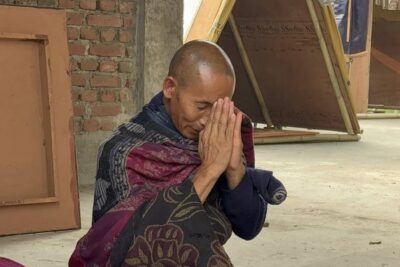

People who observe no precepts attacking those who do — this is a paradox not uncommon in spiritual communities. In Nepal on February 19, 2026, Master Minh Tue not only addressed the question but also gave a warning: even the precept-keeper can commit a serious mistake if they react in the wrong way.
Buddhist disciple asks: Some people don’t observe any precepts but attack those who observe the 5 precepts, how about that Master? (February 19, 2026 – Nepal)
Master Minh Tue answers:
They themselves will reap the consequences. But if someone observing the 5 precepts attacks them back, it is even worse. I once heard a book say that if a person observing the 5 precepts orders a person not observing precepts to take out the trash or do this and that, the one giving orders loses merit and easily falls into lower realms.
The other person doesn’t know, so they act like that; that very thing leads them down the path of suffering, and when they die, they will writhe in agony. If we know cause and effect, we feel compassion and wish that it wouldn’t happen to them.
The difficulty in life is that when people speak ill of us, we speak ill back; when people hit us, we hit back. Learning Buddhism means learning patience: when people curse us, we don’t curse back; when they hit us, we don’t hit back. Don’t pay attention to how many precepts they observe, just view them as Buddhas so we won’t touch them and lose our merit.
* Master Minh Tue always gives brief and concise answers suitable for the listener in each circumstance. Below is a deeper explanation and analysis so that those who wish to learn can thoroughly grasp the Master’s teachings.
Don’t let righteousness turn into arrogance
The Master’s teaching strikes directly at a disease very easy to catch for practitioners: “Arrogance” (conceit) because they are observing precepts. Those who observe the 5 precepts often consider themselves pure and better than loose people. Due to that hidden arrogance, when attacked, they easily get angry and “attack back.”
The Master affirms: “If someone observing the 5 precepts attacks them back, it is even worse.” Why? Because the person who doesn’t know the Dharma commits evil out of ignorance and delusion. As for you, you already know the law of cause and effect and are practicing the Buddha’s teachings, but you still harbor hatred; your wrongdoing is much greater. If you use your “virtue” to trample, despise, or order around those who are inferior (e.g., ordering someone not observing precepts to take out the trash with a condescending mind), you will dissipate all your merit.
Instead of resentment, generate compassion
An extremely compassionate perspective is opened: “If we know cause and effect, we feel compassion and wish that it wouldn’t happen to them.” When a person attacks the righteous Dharma and sabotages a practitioner, they are sowing extremely heavy evil karma. Their future will be damnation and extreme suffering (“when they die, they will writhe in agony”).
A wise person, upon seeing a blind man rushing headlong into a fire, does not get angry and curse the blind man, but feels pity. A person who understands cause and effect is the same; they do not hate the one who attacks them, they only feel sorry for that person’s bleak future.
The practice of absolute Patience
The Master summarizes the core of Buddhism: “Learning Buddhism means learning patience.” In life, everyone has the instinct of “an eye for an eye, a tooth for a tooth” (when people speak ill of us, we speak ill back). To break this instinct, the Master shows us an invaluable psychological practice trick: “Just view them as Buddhas so we won’t touch them and lose our merit.” If you visualize the person attacking you as a Buddha incarnated to test you, you will immediately maintain reverence, the anger will dissipate, and your merit will be perfectly preserved.
When you see someone who breaks precepts criticizing someone who keeps them, how do you think one should respond?
Leave a comment below to share your perspective and learn from one another.