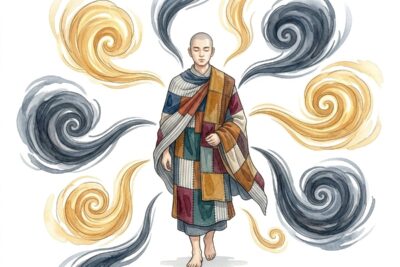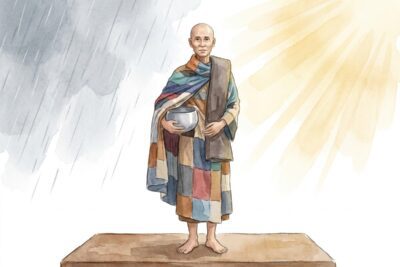
The Sanskrit and Pāli word saṃsāra is often translated as “the cycle of birth and death” or “the round of existence.” Literally, it means “wandering on” — from saṃ (“together, continuously”) and the verbal root sṛ (“to flow, to run”). It is the picture of a being carried, life after life, by the current of its own actions.
To modern ears, this can sound like a mythological cosmology best set aside. But the Buddha’s teaching on saṃsāra is not primarily a claim about metaphysics. It is a description of a mechanism — one that operates whether examined across many lives or across a single afternoon.
What Is Saṃsāra? Distinguishing It from Rebirth
Saṃsāra and rebirth (punabbhava) are related but not identical. Rebirth is the event: consciousness continuing after death into a new form of existence. Saṃsāra is the pattern: the ongoing, repeated round of such events, driven by craving and ignorance.
A single rebirth is not saṃsāra. A single birth followed by liberation ends the round. What makes saṃsāra saṃsāra is the continuation — the fact that ordinary beings, without insight, keep generating the conditions for another turn of the wheel.
The Buddha in SN 15.3 uses a striking image: “The tears you have shed while wandering on through this long round of existence, weeping and wailing over union with the unloved and separation from the loved, are more than the water in the four great oceans.” Saṃsāra is not neutral. It is the description of a state of being that, examined closely, contains far more suffering than satisfaction.
The Cause of Saṃsāra: Dependent Origination
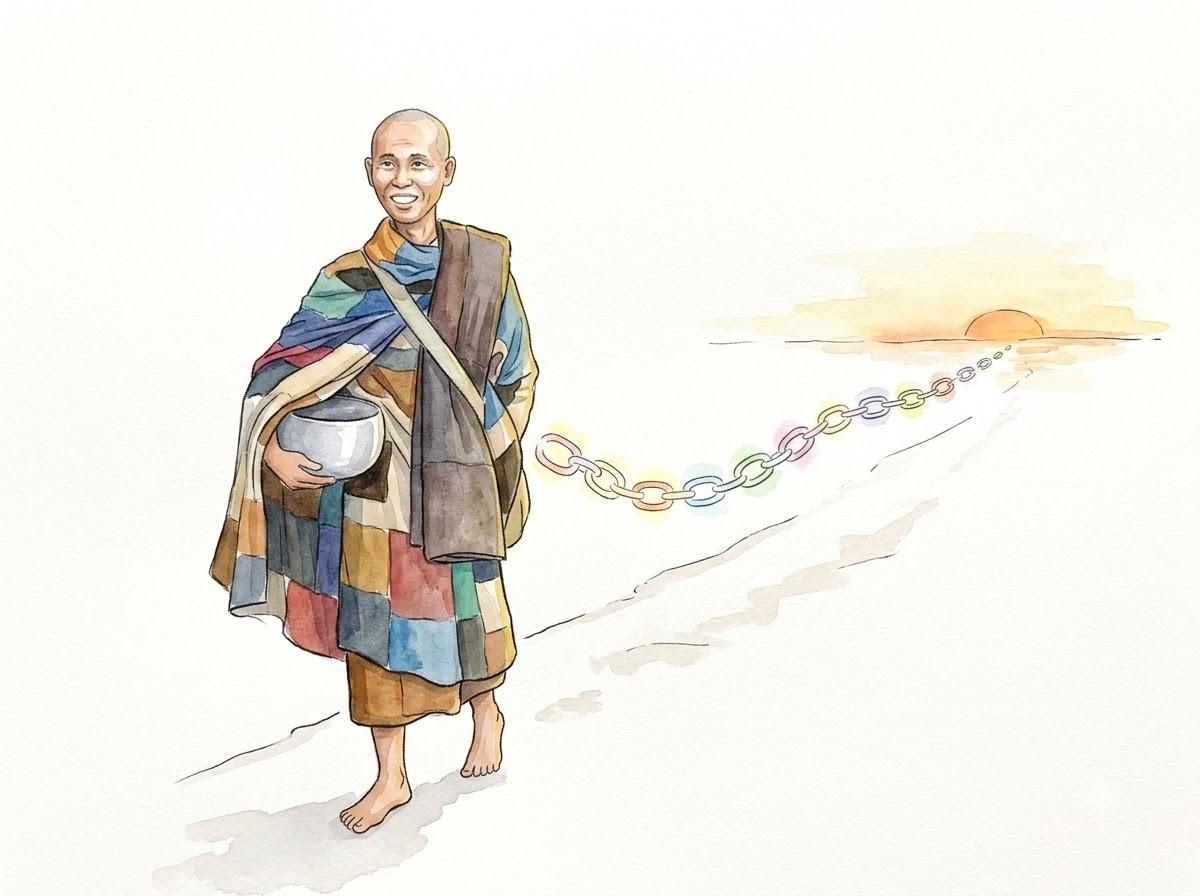
The Buddha’s diagnosis of what keeps the wheel turning is the twelve-link chain of dependent origination (paṭicca-samuppāda):
Ignorance (avijjā) → volitional formations (saṅkhārā) → consciousness (viññāṇa) → name-and-form (nāma-rūpa) → the six sense bases (saḷāyatana) → contact (phassa) → feeling (vedanā) → craving (taṇhā) → clinging (upādāna) → becoming (bhava) → birth (jāti) → aging and death (jarā-maraṇa).
Two links are the practical hinges. Ignorance is the root — not knowing the Four Noble Truths, not seeing impermanence and non-self clearly. Craving is the fuel — the constant reaching for pleasant experience and away from unpleasant experience.
Where there is ignorance and craving, the chain rolls forward. Break either link, and the sequence collapses. The Buddha’s entire path — virtue, concentration, wisdom — is engineered to weaken and finally sever these two links.
The Six Realms of Existence
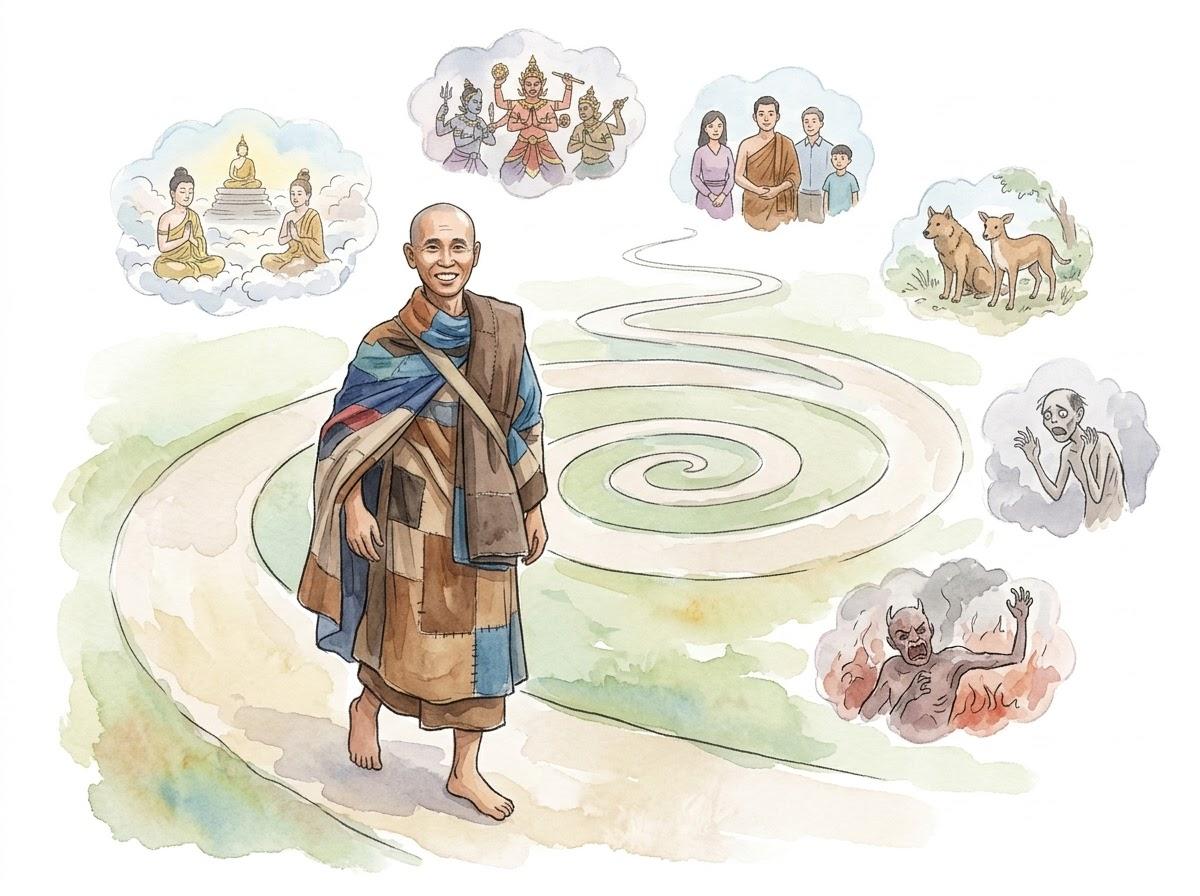
Traditional cosmology describes six realms into which beings are reborn according to their kamma:
1. The realm of gods (deva) — long lifespans of refined pleasure, but not free from decline and death.
2. The realm of asuras — powerful beings driven by envy and conflict.
3. The human realm (manussa) — the mixed condition uniquely suited to practice, because it contains both enough suffering to motivate and enough freedom to act.
4. The animal realm (tiracchāna) — driven by instinct, with little scope for reflection.
5. The realm of hungry ghosts (peta) — beings of endless craving that cannot be satisfied.
6. The hell realms (niraya) — states of intense suffering resulting from the heaviest unwholesome actions.
None of these are eternal. Even the highest heavens exhaust their supporting kamma. Even the deepest hells do not last forever. This is one of the differences between saṃsāra and eternal reward or damnation: no realm is a final destination.
Saṃsāra in a Single Moment
The Buddha’s teaching on dependent origination can be read at two scales. Across lifetimes: ignorance in one life shapes the volitional formations that condition consciousness in the next. Within a single moment: the same twelve links describe what happens in the mind whenever a sense contact leads to craving, clinging, and a new “becoming” of the self-image.
You see a phone notification (contact). A pleasant or unpleasant feeling arises (feeling). Craving to check it, or aversion to it, arises (craving). The mind grasps at the pleasant, pushes away the unpleasant (clinging). A momentary “self” comes into being around this preference (becoming). That self is “born” and immediately “dies” — replaced by the next moment’s self.
Ordinary experience, closely observed, is a rapid sequence of these micro-births and micro-deaths. Saṃsāra is not only a cosmology; it is the texture of an unliberated moment.
Escape from Saṃsāra – Nibbāna
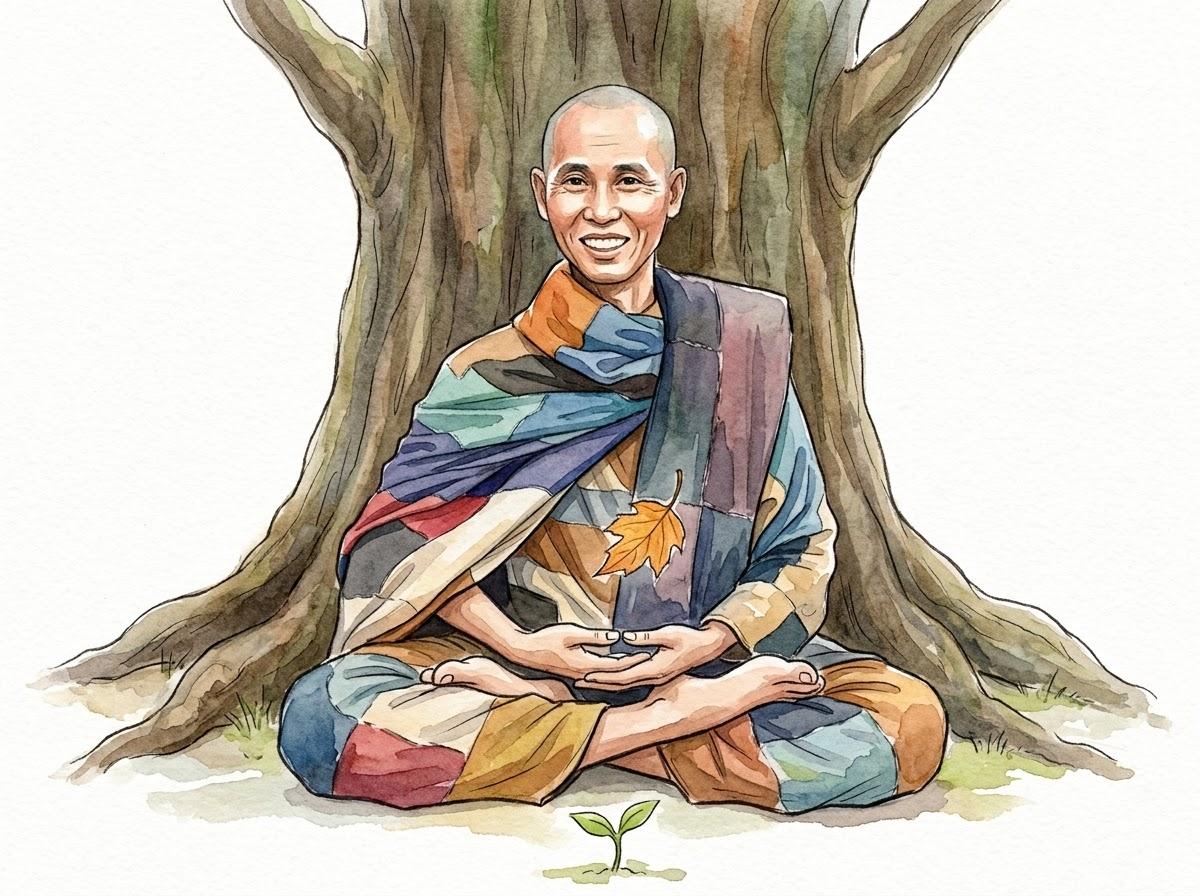
The end of saṃsāra is Nibbāna (Pāli; Sanskrit nirvāṇa) — literally “extinguishing,” as of a flame. What is extinguished is not the practitioner but the fires of greed, hatred, and delusion (rāga, dosa, moha). When these fires no longer burn, the conditions for further rebirth are absent.
Nibbāna is not annihilation and not eternal existence. The Buddha refused to describe it in either set of terms because both misrepresent it. What can be said is what is absent: no more birth, no more aging, no more death, no more sorrow. What is present is described only in negations: unconditioned, unborn, unmade, unformed (asaṅkhata, ajāta, akata, abhūta).
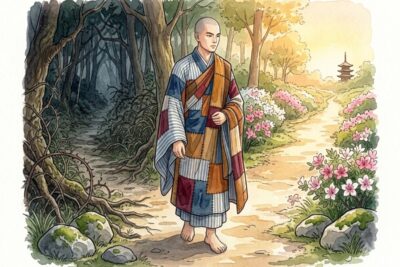
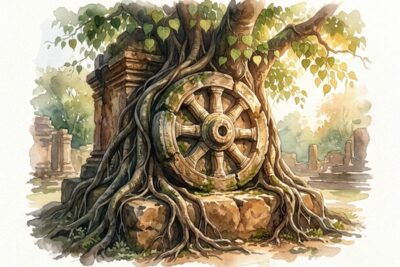
The path to this cessation is the Noble Eightfold Path. The wheel of saṃsāra turns because of craving and ignorance; the Eightfold Path is the systematic training that weakens both.
Master Minh Tuệ: Living Without Accumulation
The mechanism of saṃsāra is craving that becomes clinging that becomes becoming. Practically, clinging expresses itself as accumulation — of possessions, of relationships, of identity, of reputation. The more one accumulates, the more one must protect, and the more the mind is bound to the wheel.
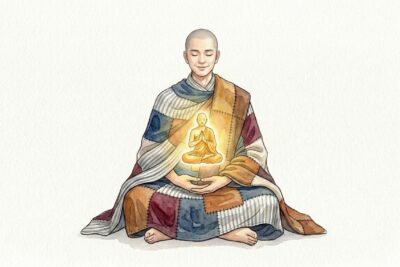
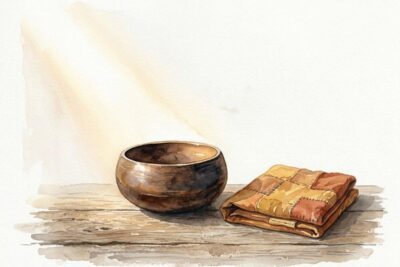
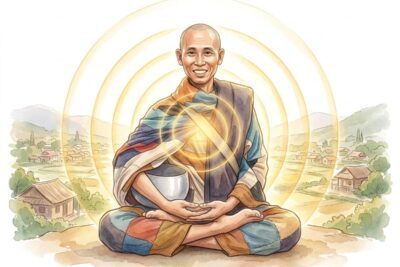
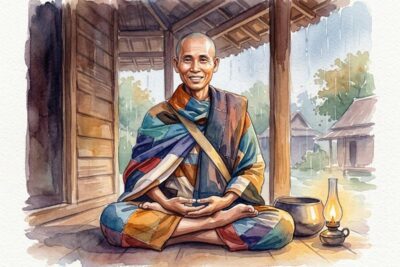
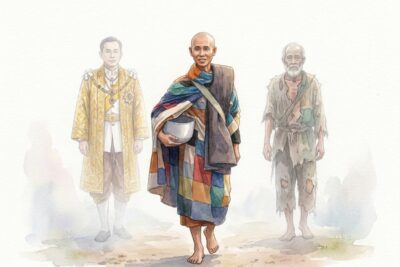
Master Minh Tuệ’s practice makes this mechanism unusually visible. He owns almost nothing — a patchwork robe (paṃsukūla), a bowl repurposed from a rice-cooker liner, no phone, no money, no bank account, no organization, no fixed dwelling. Whatever food is placed in his bowl is what he eats that day; whatever place he lies down is where he sleeps that night.
What can be observed is a life that generates almost no new attachments. Without possessions, there is nothing to defend. Without an organization, there is no institutional identity to protect. Without a fixed dwelling, there is no home to return to. Whether this arrangement corresponds to the inner cessation the Buddha described is not for observers to declare. What is visible is a way of living that does not feed the wheel.
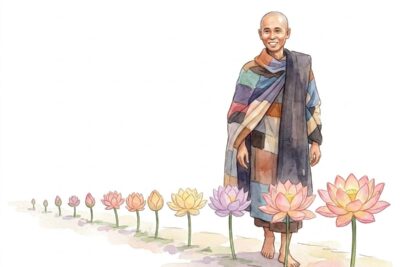
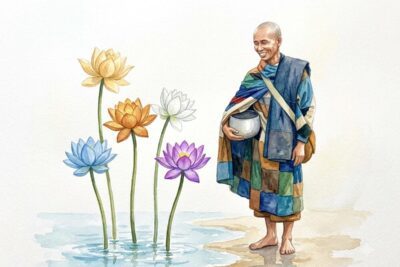
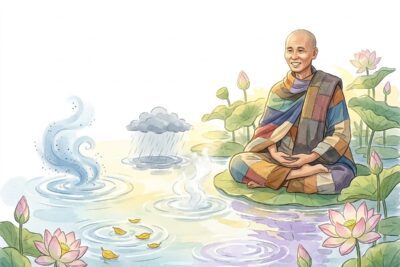
The traditional metaphor is water on a lotus leaf: contact without absorption. Circumstances arise, are met, and pass on, without accumulating a residue.
Note: This analysis is based on observable behavior, not Master Minh Tuệ’s own words about his inner experience. The actual depth of his inner development is something only the practitioner himself can know.
Application in Lay Life
Lay practitioners do not need to abandon possessions to work with the teaching on saṃsāra. What matters is direct observation of the mechanism.
Notice, in a single day, how many times craving arises: for a snack, for a message, for approval, for stimulation. Notice how each craving, when acted on, produces a brief satisfaction and a new craving in its wake. This is saṃsāra at the smallest scale — and it is the scale on which liberation begins.
Where craving is seen clearly, it loses some of its grip. Where it loses its grip, clinging weakens. Where clinging weakens, the sequence begins to slow. The wheel does not stop all at once; it slows by degrees, over years of noticing.
Related: The Four Noble Truths, The First Discourse, The Noble Eightfold Path.
Frequently Asked Questions
Q1. Do I have to believe in literal rebirth to practice Buddhism?
The core practice functions on its own terms. The teaching on saṃsāra can be applied at the scale of a single moment even by those who set aside questions of literal rebirth. Serious practice tends, over time, to shift one’s view.
Q2. Is saṃsāra the same as karma?
No. Kamma is action and its result. Saṃsāra is the ongoing round of existence within which kamma operates. Kamma is the mechanism; saṃsāra is the pattern.
Q3. Are the six realms literal places?
Traditional Buddhism describes them as literal, and also as states of mind visible in this life. Both readings can be practiced with; the psychological reading in particular is directly verifiable.
Q4. What is the fastest way to weaken saṃsāra?
Sustained attention to craving as it arises. Every craving noticed and not acted on is a small break in the chain. Over time, these breaks compound.
Q5. Is Nibbāna extinction of the person?
No. What is extinguished is greed, hatred, and delusion — not a self, because in the Buddhist analysis there was never a self of that kind to begin with. What remains after the fires go out cannot be captured in ordinary categories.