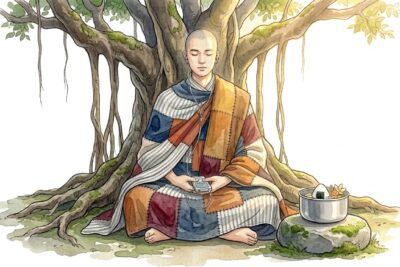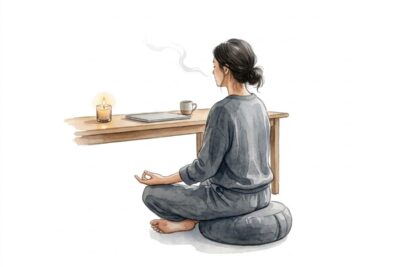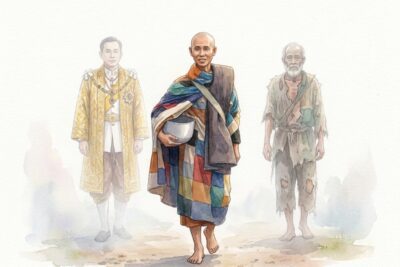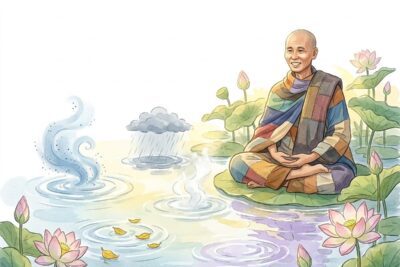
People often picture Buddhist practice as sitting still — eyes closed, back straight, breath steady. That image isn’t wrong, but it isn’t complete.
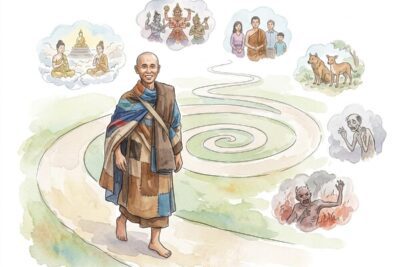
From the Buddha’s own time, monks did not sit all day. They walked — on alms round each morning, from village to village to share the Dhamma, in walking meditation to train the mind. The Buddha himself walked thousands of kilometers over 45 years of teaching across the Ganges plain.
Walking was not simply the only available mode of transport before motorized vehicles. It was a form of practice.
Two Meanings of Walking in Buddhism
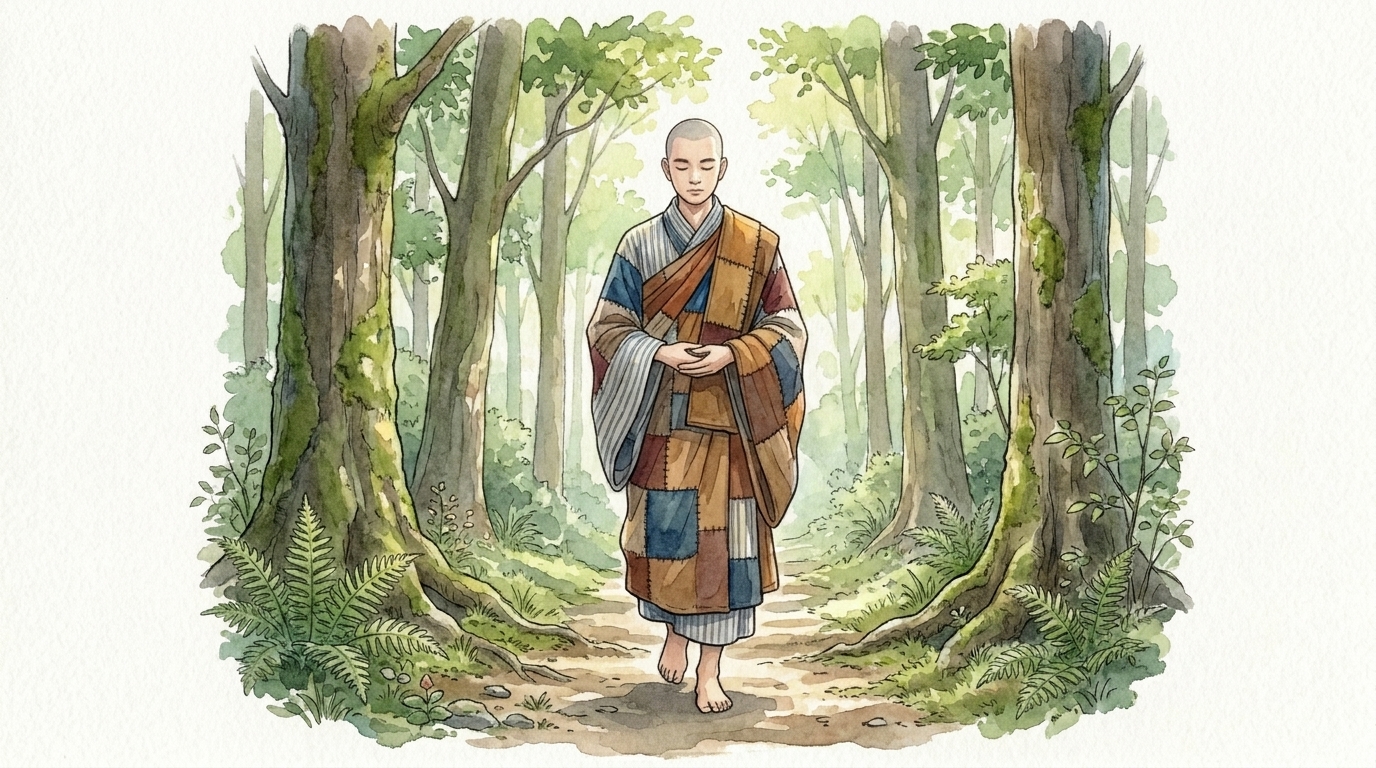
When “walking” is mentioned in a Buddhist context, two distinct meanings are often used interchangeably:
Walking meditation (cankama) — walking as a form of meditation practice, typically in a short defined space with the deliberate intention of training mindfulness. An inner practice that can be done anywhere.
Pilgrimage on foot — walking long distances to sacred sites or as part of an open-ended practice journey. A practice that combines training body and mind with orientation toward the Buddha’s land.
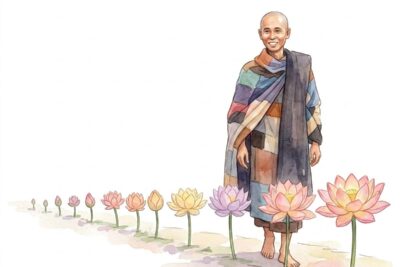
Thay Minh Tue practices both — each step is walking meditation, and the entire many-year journey is pilgrimage. The two are not separate in his life.
Walking Meditation – Meditation in Every Step
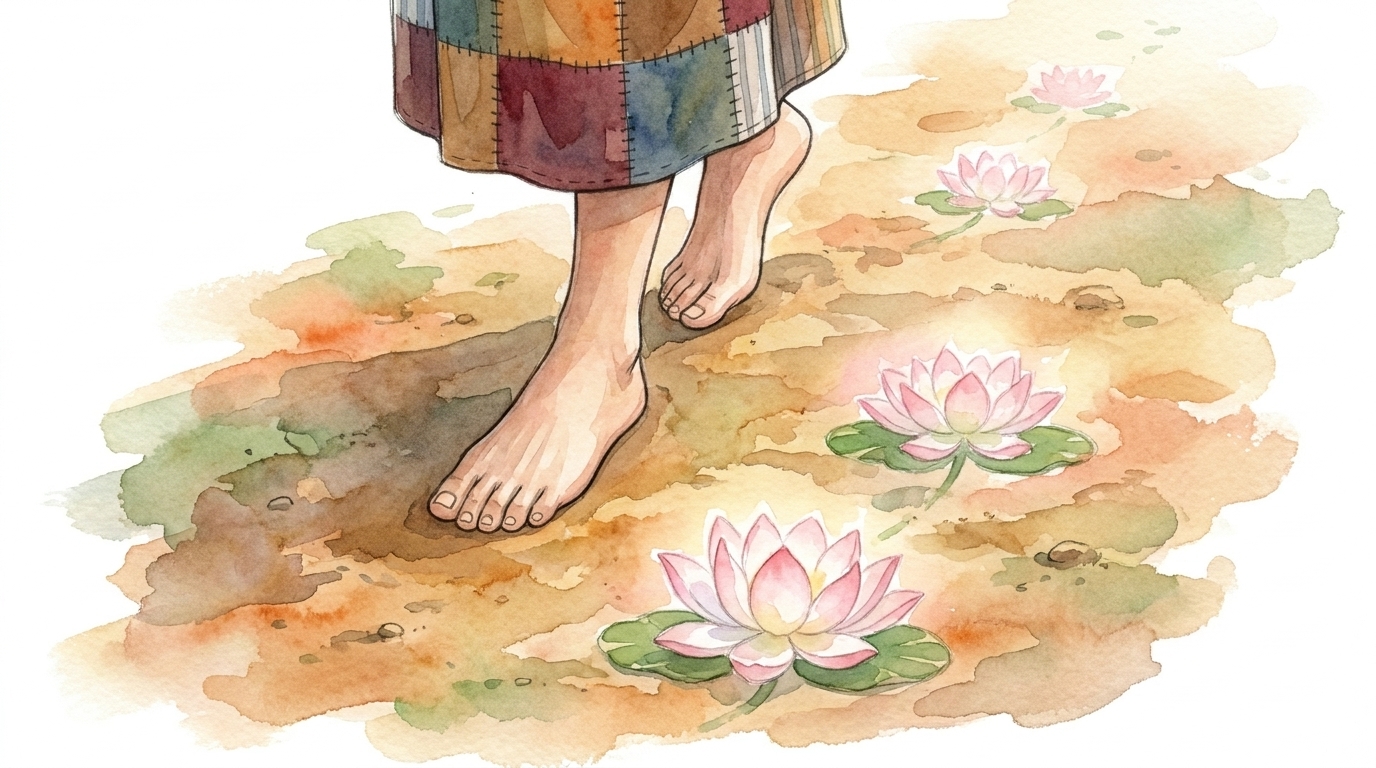
Its origins in the scriptures
Cankama (Pali) is mentioned by the Buddha many times in the canon as one of the four primary postures of a practitioner: walking, standing, lying down, sitting. The Buddha did not merely permit mindful walking — he pointed out specific benefits of walking meditation that seated practice does not provide.
In the Aṅguttara Nikāya, the Buddha taught that one who practices walking meditation gains five benefits: the ability to endure long journeys, the capacity to sustain effort, less illness, better digestion of food, and — most notably — concentration developed in walking meditation is more durable. Concentration developed in seated practice sometimes lasts only through a sitting, dissolving when one stands up. Concentration trained through walking meditation penetrates more deeply into all the activities of daily life.
How to practice walking meditation
Walking meditation is not a stroll or exercise. The difference lies in deliberate attention:
The practitioner chooses a short path — typically ten to twenty steps — and walks back and forth along it. Slower than normal pace. Attention is placed on the sensations of the foot meeting the ground: the heel making contact, the sole spreading, the toes lifting. When the mind wanders into thought, gently return it to the sensation of the step.
It sounds simple. But when actually tried, most people discover their mind wanders continuously — after two or three steps, they are no longer aware they are walking. That is precisely when walking meditation becomes useful: noticing where the mind has gone and bringing it back — the core skill of mindfulness, trained not on a cushion but on a path.
Walking meditation and seated practice support each other
Many meditators find that alternating seated practice and walking meditation makes each session more effective: prolonged sitting easily leads to drowsiness and dullness, while walking revives energy and sustains wakefulness. Conversely, too much walking without time to sit quietly can make the mind extroverted and lose depth.
The Buddha often advised monastics to alternate between the two — which is why traditional Theravāda monasteries typically have both meditation halls and outdoor walking paths.
Walking Pilgrimage – When the Entire Life Becomes the Road
Why do Buddhist practitioners make pilgrimage on foot?
Pilgrimage to sacred sites — temples, holy mountains, or places associated with the Buddha’s life — is a tradition thousands of years old. But what makes pilgrimage different from ordinary spiritual tourism is precisely the mode of travel: on foot, slowly, sometimes over many months or years.
Why not travel by vehicle and arrive quickly?
Because in genuine pilgrimage, the journey matters as much as the destination. Each step is an opportunity to practice. Each day of rain or sun, hunger or fullness, exhaustion or energy — all are teachings. The inconvenience and slowness are not the cost of pilgrimage — they are the pilgrimage.
When you travel by vehicle, you arrive at a destination. When you walk, you become the journey.
Walking pilgrimage traditions in Buddhist countries
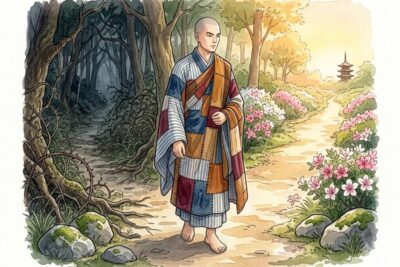
In Thailand and Myanmar, monks of the Tudong (Dhutanga) tradition often undertake long walking journeys deep into forests, living by alms and sleeping at tree roots — very close to what Thay Minh Tue practiced in Vietnam.
In Japan, the famous Shikoku 88 pilgrimage covers 1,200 kilometers around Shikoku island, passing through 88 temples associated with the monk Kūkai. Many people complete the entire circuit on foot.
In Tibet, pilgrims sometimes practice prostration walking — every three steps, prostrating fully, the whole body touching the ground — for the entirety of the journey to Lhasa, sometimes lasting an entire year.
What all these traditions share: walking pilgrimage is a way of bringing the whole body into practice, not just a mind sitting in meditation while the body waits outside.
Thay Minh Tue – Living Walking as Naturally as Breathing
In Vietnam (2018–2024): Four journeys, quiet and thorough
From 2018, Thay Minh Tue began walking across Vietnam. Not once — but four times, from south to north and back, covering tens of thousands of kilometers on bare feet.
Throughout all those years, almost no one knew of him. No followers, no cameras, no recognition. He walked because he was practicing — as simply and completely as that.
Each step was walking meditation. Each day was a full practice: rising early, going on alms round, eating one meal, continuing to walk, sleeping under a tree or in the open air. No fixed destination — only the road and the presence on it.
Those who happened to encounter him during this period describe: he walked very slowly, very evenly, eyes directed slightly downward — not looking around. That is the gait of someone in walking meditation, not someone hurrying somewhere.
2024: When the journey met crowds
In early 2024, his fourth journey began attracting widespread attention. From a few people, to dozens, then hundreds and thousands lining the roads to watch and walk with him.
This brought an entirely new kind of challenge: walking in solitude is one thing; walking through a loud crowd is something completely different. Mindfulness in silence is easier than mindfulness amid noise, camera flashes, and hundreds of questions from all sides.
But he kept walking. Same pace, same gait, same equanimity. The external form changed, but what was happening inside — each step a step of awareness — appeared unchanged.
In June 2024, when the crowd grew so large that it created traffic hazards in central Vietnam, the domestic journey paused. He did not respond to this with frustration or protest — he accepted it and continued finding the next path.
December 2024 to the present: Toward the Buddha’s land
In December 2024, Thay left Vietnam for Laos — beginning a pilgrimage toward the land of the Buddha: India and Nepal, where the Buddha was born, attained enlightenment, and passed away.
The international journey brought entirely different circumstances: visa time limits, each country’s laws, language barriers. Many stretches required taking transport rather than walking — something Thay always states clearly is unavoidable, not an abandonment of his vow.
But when he can walk, he walks. And whether walking or not, the spirit of the pilgrimage — full presence on the road, one step at a time, neither grasping nor refusing — remains the way he is living.
In September 2025, he arrived in Nepal on a one-year visa. The journey continues.
What Walking Teaches That Books Cannot
There are things that can only be learned by setting foot on the road and walking.
When you walk long enough, far enough, with little enough — you begin to notice what comfortable life conceals: the body needs very little to survive. Most of what we call “necessary” is habit and expectation. As those things are gradually stripped away through day after day of walking, the mind begins to lighten in turn.
Walking also teaches healthy dependence: each day, whether there is food or not depends on the kindness of strangers. That cannot be controlled. And when you cannot control it yet remain well — that is the moment genuine letting-go actually happens, not in words or theory.
Lay practitioners do not need to walk for years to understand this. But sometimes, instead of taking a vehicle, try walking a familiar stretch of road — slower, more attentive, no music, no phone. Just walking and knowing you are walking.
That is the first step of walking meditation entering real life.
Learn more: who is Thầy Minh Tuệ?Biography, the dhutanga practice and the walking pilgrimage.Read more →