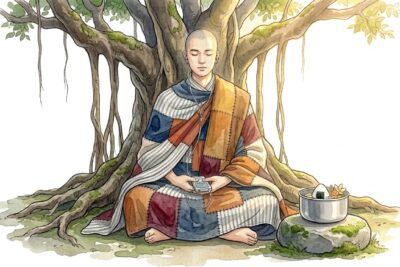
Every year, millions of people around the world attend Vipassana retreats — many of them not Buddhist, not interested in scriptures, simply wanting a method to quiet a restless mind and find relief from suffering.
That fact says something important about Vipassana: it is universal enough to cross religious boundaries, practical enough for modern people to apply, and deep enough to become a lifelong path for those who want to go further.
But what is Vipassana? And why is it the heart of practice in Theravāda Buddhism?
What Does Vipassana Mean?
Vipassanā in Pali is composed of two parts: vi (clearly, deeply) and passanā (seeing). Vipassana means “seeing clearly” or “seeing through” — seeing things exactly as they are, without the filter of expectation, fear, or bias.
Samatha and Vipassana – Two Wings of One Bird
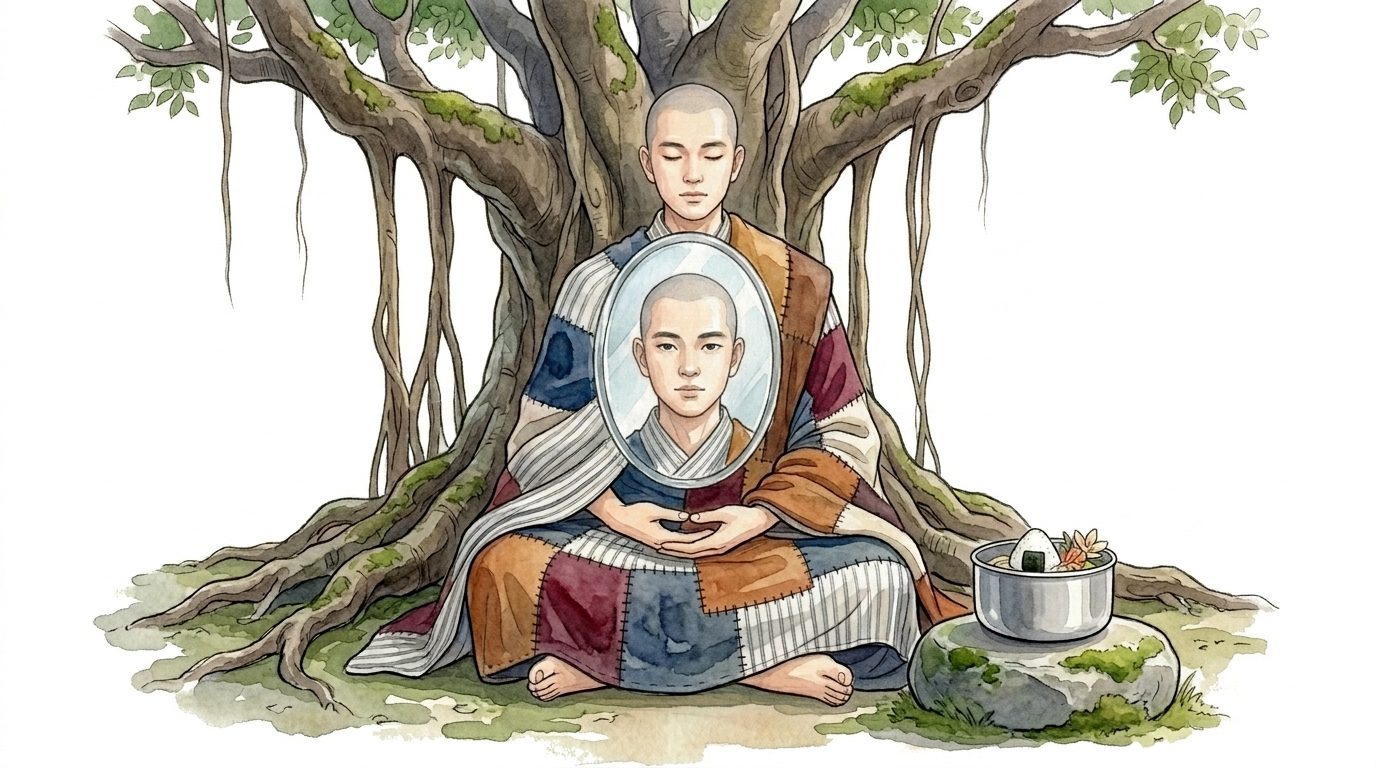
To understand Vipassana, it helps to know how it differs from the other main form of Buddhist meditation: Samatha (Calm Abiding).
Samatha — meaning stillness, tranquility — is concentration practice focused on a single object (the breath, an image, a sound) to bring the mind into deep quiet. The goal is for the mind to settle, temporarily released from agitation. This is the path to the four jhānas.
Vipassana — is direct contemplation of the nature of body and mind in order to see clearly impermanence, suffering, and non-self. The goal is not merely a quiet mind, but wisdom arising from that quiet — wisdom that uproots the very roots of craving and delusion.
If Samatha is quieting the mind, Vipassana is using that quiet to see reality clearly.
The Buddha taught both as necessary and mutually supporting — like two wings of a bird. Samatha creates the stable foundation of concentration for Vipassana to see clearly. Vipassana uses insight so the mind is not pulled back into craving after emerging from Samatha.
In Thay Minh Tue’s practice — and in the Theravāda tradition generally — Vipassana is the primary meditation, with Samatha as its supporting foundation.
The Scriptural Basis: The Satipaṭṭhāna Sutta
Vipassana has its direct scriptural foundation in the Satipaṭṭhāna Sutta (Discourse on the Four Foundations of Mindfulness) — one of the most important texts in Theravāda Buddhism.
The Buddha opens this discourse with an unusually bold declaration:
“This is the one direct path for the purification of beings, for the surmounting of sorrow and lamentation, for the disappearance of pain and grief, for the attainment of the right method, for the realization of Nibbāna — namely, the four foundations of mindfulness.”
“The one direct path” — these words emphasize the centrality of Vipassana through the four foundations. Those four are:
- Contemplation of the body (kāyānupassanā): observing the body — breath, posture, movement, bodily parts
- Contemplation of feeling tones (vedanānupassanā): observing whether experience is pleasant, unpleasant, or neutral
- Contemplation of mind (cittānupassanā): observing mental states — with or without greed, with or without aversion, clear or deluded
- Contemplation of mental phenomena (dhammānupassanā): observing psychological processes — the five hindrances, the aggregates, the sense bases
Practicing Vipassana through the four foundations means continuously observing these four domains with mindful, non-judgmental awareness — not interfering, not correcting, simply seeing clearly what is happening.
What Happens When We Practice Vipassana?
When first beginning, most practitioners make a startling discovery: the mind never stops.
Within five seconds of sitting still, the mind has thought about dinner, recalled something said yesterday, made plans for the weekend, worried about an unanswered email. All of it automatic, continuous, uninvited.
This is not a failure in meditation — it is the first and most important observation: seeing clearly how the mind actually operates, not how we imagine it does.
From that observation, practice deepens over time:
Early stage: Noticing where the mind has gone. Returning it to the breath or body sensation. Repeating endlessly.
Middle stage: Beginning to recognize patterns in the mind — habitual reactions to unpleasantness (wanting to escape), to pleasantness (wanting to hold on), to neutrality (boredom, dullness). This is when the three characteristics — impermanence, suffering, non-self — begin to be seen directly in experience, not just understood as theory.
Deeper stage: Clinging and resistance begin to ease — not because we are trying to let go, but because it has become clear that clinging doesn’t deliver what we want and resistance doesn’t change reality. When this is seen clearly enough times, the mind naturally learns to let things come and go without being swept along.
Vipassana in Daily Life
A common misunderstanding is that Vipassana only happens during sitting practice. In reality, the peak of Vipassana is maintaining this contemplation throughout all activities — eating, walking, talking, working.
The Buddha called this sati sampajañña — mindfulness combined with clear comprehension. Not only knowing what you are doing (mindfulness), but clearly understanding why, with what attitude, and what is happening in the mind while doing it (clear comprehension).
This is why serious Vipassana practitioners do not separate “meditation time” from “living time” — all of life is meditation, every moment an opportunity for contemplation.
Thay Minh Tue and Vipassana
Thay Minh Tue does not present himself as a “Vipassana teacher” or as following any particular Vipassana school. But observing his journey and life, Vipassana practice is clearly present at multiple levels.
Walking meditation as continuous Vipassana
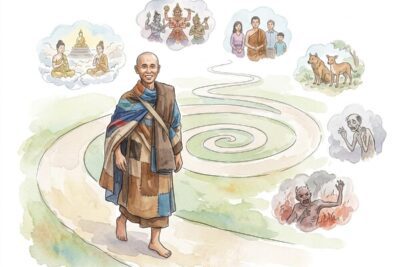
Each step on Thay’s walking journey is a step of body contemplation. Walking in mindfulness — attention on the sensation of feet meeting the ground, the breath, the body’s movement — is kāyānupassanā practiced without interruption. Not in a short sitting, but for tens of kilometers each day, for many years running.
Equanimity toward feeling tones
Vipassana places particular emphasis on observing vedanā — pleasant or unpleasant feeling tones — without automatic reaction. On the walking road, Thay faces unpleasant sensations continuously: heat, rain, hunger, fatigue, aching feet. His equanimity before all of this is not because he doesn’t feel — but because he is not swept away by what he feels. This is the sign of deeply practiced vedanānupassanā.
A mind undisturbed by praise or criticism
When people praise him, he does not swell. When people doubt or criticize him, he does not deflate. This is the result of cittānupassanā — observing mental states long and deeply enough that one is no longer identified with them. A state of praise arises — he sees it. A state of criticism arises — he sees it. Both come and go, leaving no residue.
Answering Dhamma questions from direct insight
When asked about the Dhamma, Thay answers quickly, clearly, and consistently with scripture — but not through mechanical citation. His answers carry the breath of someone who has seen these things from inside, not only learned them from outside. This is Vipassana leading to genuine wisdom — bhāvanāmayā paññā — wisdom arising from practice, not from memorization.
How to Begin Vipassana
No need to immediately attend a 10-day retreat to begin. Vipassana can be introduced into ordinary life through small steps:
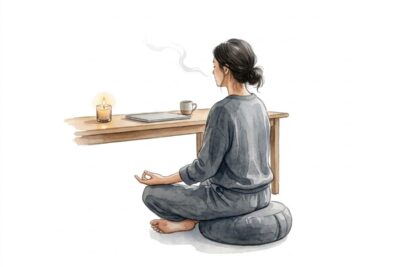
Step 1 — Observe the breath: Take 10 minutes each day simply watching the breath coming and going. No adjusting, no special breathing. When the mind wanders — notice it, return. This is the foundation.
Step 2 — Notice feeling tones: During the day, when something feels pleasant or unpleasant, pause for a moment and notice: “This is a pleasant feeling. I want to hold onto it.” or “This is an unpleasant feeling. I want to push it away.” Just noticing — nothing more is needed.
Step 3 — Observe automatic reactions: When someone says something that makes you angry or hurt, before reacting, try pausing and observing: “What is happening in my mind right now?” No judgment — just observation.
These three steps, practiced regularly in daily life, are how Vipassana begins to permeate each moment — not only on a meditation cushion, but on every road we walk.
Learn more: who is Thầy Minh Tuệ?Biography, the dhutanga practice and the walking pilgrimage.Read more →