If the Noble Eightfold Path is a detailed map with eight roads, then Ethics–Concentration–Wisdom is the way of folding that map into three essential points — three stages anyone on the path must pass through, in exactly that sequence.
It sounds simple. But within that simplicity lies a very precise architecture: each stage is the necessary foundation for the next. Skip or reverse the order, and the path leads nowhere.
Why Must the Order Be Ethics First, Then Concentration, Then Wisdom?
Think of it this way.
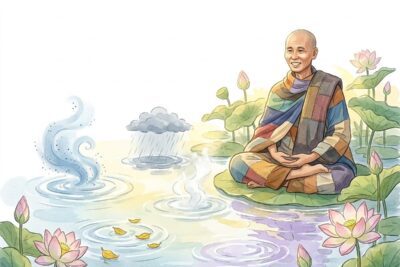
You want to see the bottom of a pond clearly. The first condition is the water must not be stirred up — no mud, no debris, no waves. That is Ethics: when life is not churned up by harmful actions, the mind begins to clear.
The second condition is the water must be still — no wind, no vibration. That is Concentration: when the mind is not constantly moving from thought to thought, it begins to settle.
When the water is both clear and still — you can finally see to the bottom. That is Wisdom: insight that sees the true nature of things, seeing impermanence, non-self, and the path out of suffering.
Wisdom cannot arise without Concentration. Concentration cannot arise without Ethics. This is not an arbitrary rule — it is a description of how the mind actually functions.
Ethics (Sila) – The Moral Foundation
What is Sila?
Sila in Pali is often translated as “precepts” or “morality” — but that rendering can make it sound like an external rulebook being imposed. In Buddhism, the precepts are a voluntary commitment not to cause harm — arising from understanding, not from fear or submission.
The Buddha was not a lawgiver. He did not issue precepts because he held authority. He taught them because harmful actions create consequences — first and foremost within the mind of the person who commits them.
When we lie, deceive, or harm another — even if undetected, even without legal consequence — the mind is disturbed. Something inside knows. That disturbance accumulates and becomes a barrier to concentration and wisdom.
Conversely, when life is clean in body and speech — the mind naturally becomes lighter. Not because it is rewarded, but because the weight of concealment, regret, and fear of consequence is lifted.
Who are the precepts for?
Buddhism has different sets of precepts for different practitioners:
- Five Precepts — the basic five for lay people
- Eight Precepts — observed on full moon and new moon days
- Ten Precepts — for novice monastics
- Bhikkhu Precepts — 227 rules (in Theravāda) for fully ordained monks
More precepts do not mean “more suffering” or “holier” — they reflect an increasingly deep commitment to letting go and an increasingly subtle attention to not causing harm.
Concentration (Samadhi) – A Stable, Still Mind
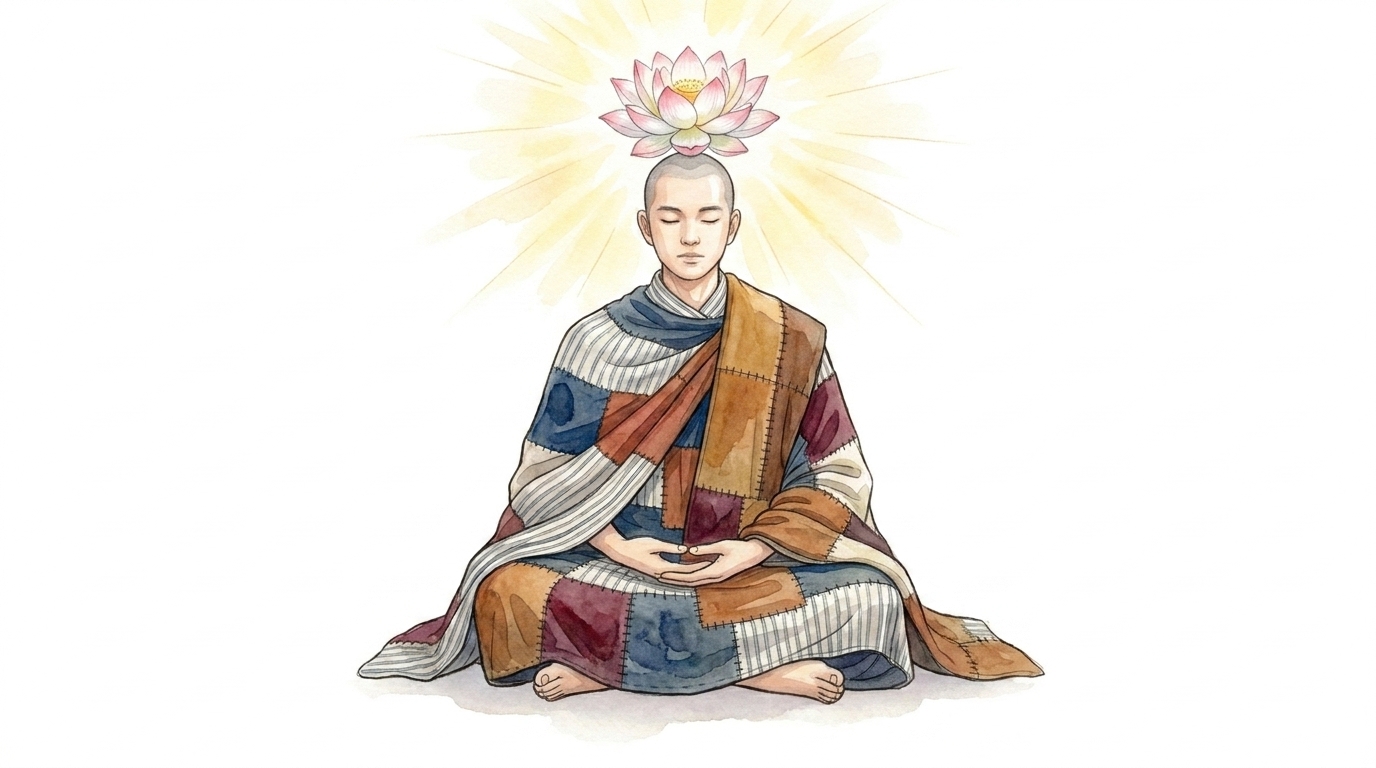
What is Samadhi?
Samadhi is the state of deep and sustained focus on a single object, undistracted by the continuous stream of thoughts. This is not an unconscious or drowsy state — it is complete wakefulness in stillness.
In ordinary life, our mind rarely truly stops. It jumps from thought to thought, from plans for the future to regrets of the past, from one worry to another desire. Even sitting quietly, the mind is still running.
Concentration is the capacity to bring the mind back and keep it there — not by forcing or suppressing thought, but by patiently noticing when the mind has wandered and gently returning it to the object of meditation.
How are Ethics and Concentration connected?
This is the key point many people miss when learning to meditate.
Many people learn meditation without keeping precepts — sitting for hours while daily life still includes lying, causing harm, and living in internal contradiction. The result is that the mind cannot truly settle. It may be temporarily quiet during a sitting, but the roots of disturbance remain.
The Buddha described Ethics as the “foundation” and Concentration as the “house built upon it.” An unstable foundation means the house cannot stand. Keeping precepts cleanly is not about scoring points — it is the practical condition for the mind to settle deeply enough.
The Four Stages of Deep Meditation (Jhana)
Concentration deepens through four stages, the Jhānas:
First Jhana — the mind separates from sensual desire and unwholesome states; applied thought (vitakka) and sustained attention (vicāra) are present; joy and happiness born from seclusion arise.
Second Jhana — applied thought and sustained attention subside; the mind becomes more internally clear; joy and happiness born from concentration.
Third Jhana — joy subsides; only a quiet happiness and equanimity remain.
Fourth Jhana — both happiness and suffering are transcended; only pure equanimity and fully lucid mindfulness remain.
The Fourth Jhāna is the foundation from which deep insight can arise.
Wisdom (Panna) – Insight That Sees Reality Clearly
What is Panna?
Panna is not knowledge accumulated through books or intelligence in the ordinary sense. This is direct insight — seeing clearly with one’s own mind, without the intermediary of reasoning or concepts.
Specifically, Wisdom is the capacity to see the three characteristics of all phenomena as they actually are: impermanence, suffering, and non-self. Not understanding them intellectually — but seeing them directly in each moment of experience.
When Wisdom is sufficiently deep and mature, it leads to natural releasing — not effortful letting go, but releasing naturally because one has clearly seen there is nothing worth clinging to.
Wisdom from learning versus wisdom from practice
Buddhism distinguishes two kinds of wisdom:
Wisdom from learning (sutamayā paññā) — understanding through study, listening to teachings, reading scriptures. A necessary first step but not sufficient.
Wisdom from practice (bhāvanāmayā paññā) — wisdom arising directly from meditation practice. This is the wisdom the Buddha identified as the path out of suffering.
Knowing about impermanence and actually seeing impermanence in each moment are very different things. Someone who can lecture beautifully about impermanence yet still clings and suffers deeply when facing loss — that person has wisdom from learning. One with wisdom from practice is different.
How the Three Stages Support Each Other
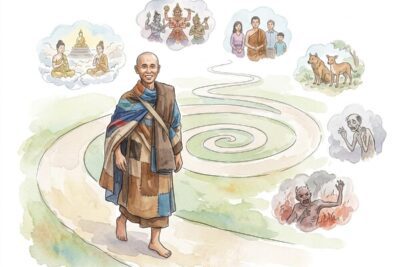
Ethics–Concentration–Wisdom are not three steps completed and then discarded. They mutually support and nourish each other in a continuously developing spiral:
Ethics creates the foundation for Concentration. Concentration creates the conditions for Wisdom to arise. Deeper Wisdom makes Ethics more natural — no longer effortful, but natural because one has clearly seen the consequences of transgression. More stable Ethics deepens Concentration further. And so the upward spiral continues.
This is why long-practicing monastics do not find keeping precepts burdensome — on the contrary, they find it the most natural and effortless thing, because it has become part of who they are.
Thich Minh Tue and Ethics – Concentration – Wisdom
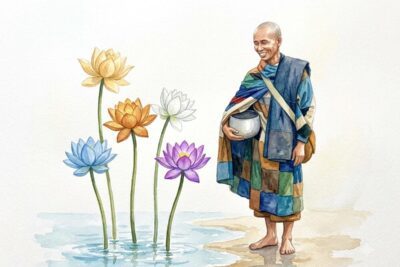
Thay Minh Tue’s journey is a living demonstration of all three stages practiced fully and consistently.
Ethics — Strict and natural
Thay keeps the bhikkhu precepts with 227 rules, combined with the 13 Dhutanga practices. But what is remarkable is not the number of precepts — it is how he keeps them: not from fear of criticism, not to earn admiration, but entirely voluntarily and silently.
During the many years of walking before 2024 when no one knew of him, he kept the precepts just the same. No audience, no cameras — the precepts remained intact. That is Ethics arising from within, not from external pressure.
He does not lie, even a single word. Does not accept money, even a single coin. Does not harm living creatures, however small. Does not keep anything beyond what is needed for a single day. These are not efforts — they are the natural way he lives.
Concentration — Each step is meditation, the mind does not waver
Every step in Thay’s pilgrimage is a step of meditation practice. Walking meditation (cankama) — walking in complete mindfulness — is one of the concentration methods the Buddha particularly encouraged.
Perhaps the clearest evidence of Thay’s concentration is a detail few people notice: during the many years he walked alone and quietly across Vietnam, he often slept at cemeteries. Not occasionally — but regularly, as part of the Dhutanga cemetery-dwelling practice.
A cemetery is a place most people dare not visit at night, let alone sleep there alone. That fear is not irrational — it arises from deep psychological responses to death, the unknown, to absolute darkness and solitude. Someone who can sleep quietly there, night after night, is not reckless — they are someone whose mind genuinely stands still, undisturbed by fear or imagination.
That is concentration at a level few people in modern life can even imagine.
Then there is how Thay faces external upheaval. Since becoming widely known, he has endured enormous pressure: crowds of tens of thousands surrounding him, doubt and criticism from many directions, continuous unexpected situations abroad, expired visas, forced changes of transport. He remains consistently calm and at ease — not a forced serenity or social smile, but a genuine stillness radiating from within.
In meditation, that state is called upekkhā — equanimity: the mind not pulled high by favorable circumstances, not pulled low by adverse ones. That is not innate personality or luck — it is the result of many years of Concentration continuously trained.
Wisdom — Expressed through teaching and through silence
Wisdom is the hardest to observe from outside — because its nature is internal. But there are indirect signs worth noting.
The first thing many people notice: when practitioners ask Thay about the Dhamma, he responds quickly, clearly, and accessibly — consistent with scripture. No long pauses, no roundabout answers, no complex academic language. He draws directly from the canon, explains in simple words, and the listener understands immediately.
This does not come from memorizing scriptures. Someone who has memorized but not directly seen tends to answer more slowly, at greater length, and loses the thread when a question comes from an unexpected angle. The quickness and precision in Thay’s words reflect something: the Dhamma is not merely stored in his memory — it has been directly seen through practice. Once seen, the answer comes naturally, like describing an object that is right in front of you.
The second sign: Thay never claims attainment of any kind. In Buddhism, someone with genuine Wisdom tends to speak less about Wisdom — because they clearly see the risk of pride lurking in declarations of having attained something. Silence about attainment is not performed humility — it reflects deep understanding of the nature of Wisdom and the danger of clinging to “spiritual achievement.”
A Starting Point for Lay Practitioners
The three stages of Ethics–Concentration–Wisdom are not only for monastics. Lay practitioners can begin at a scale suited to their lives:
Ethics: Start with the Five Precepts. No need for perfection immediately, but honest awareness when a precept is broken.
Concentration: Ten to fifteen minutes each day sitting quietly watching the breath. No need to reach the Fourth Jhāna — just building the habit of returning the mind when it wanders.
Wisdom: In daily life, occasionally pause and ask: “What am I clinging to right now? Does this truly last?”
These three small steps — practiced regularly in that sequence — are how Ethics–Concentration–Wisdom begins to be built, one small brick each day.
Learn more: who is Thầy Minh Tuệ?Biography, the dhutanga practice and the walking pilgrimage.Read more →