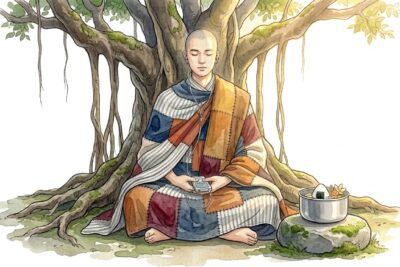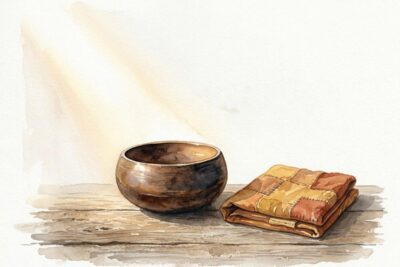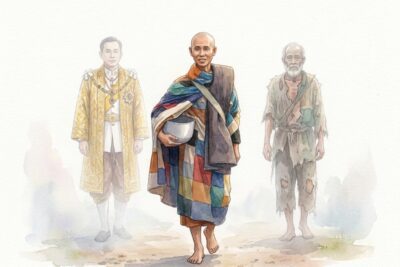
More than 2,500 years ago, after his awakening beneath the Bodhi Tree, the Buddha began his life of teaching with exactly these possessions: three robes and one bowl.
No home. No belongings. No luggage.
What is remarkable is that over the 45 years that followed — walking thousands of kilometers across kingdoms, meeting kings and the destitute, delivering thousands of teachings — he never added a single thing to that list. Three robes and one bowl. That was all.
The modern mind looks at this and tends to ask: “What can you possibly accomplish living like that?”
The student of Dhamma asks the opposite: “What is there left to hold you back?”
That is the question the Triple Robe and Bowl poses — not about deprivation, but about a very specific kind of freedom: freedom from the weight of possession.
What Are the Triple Robe and Bowl?
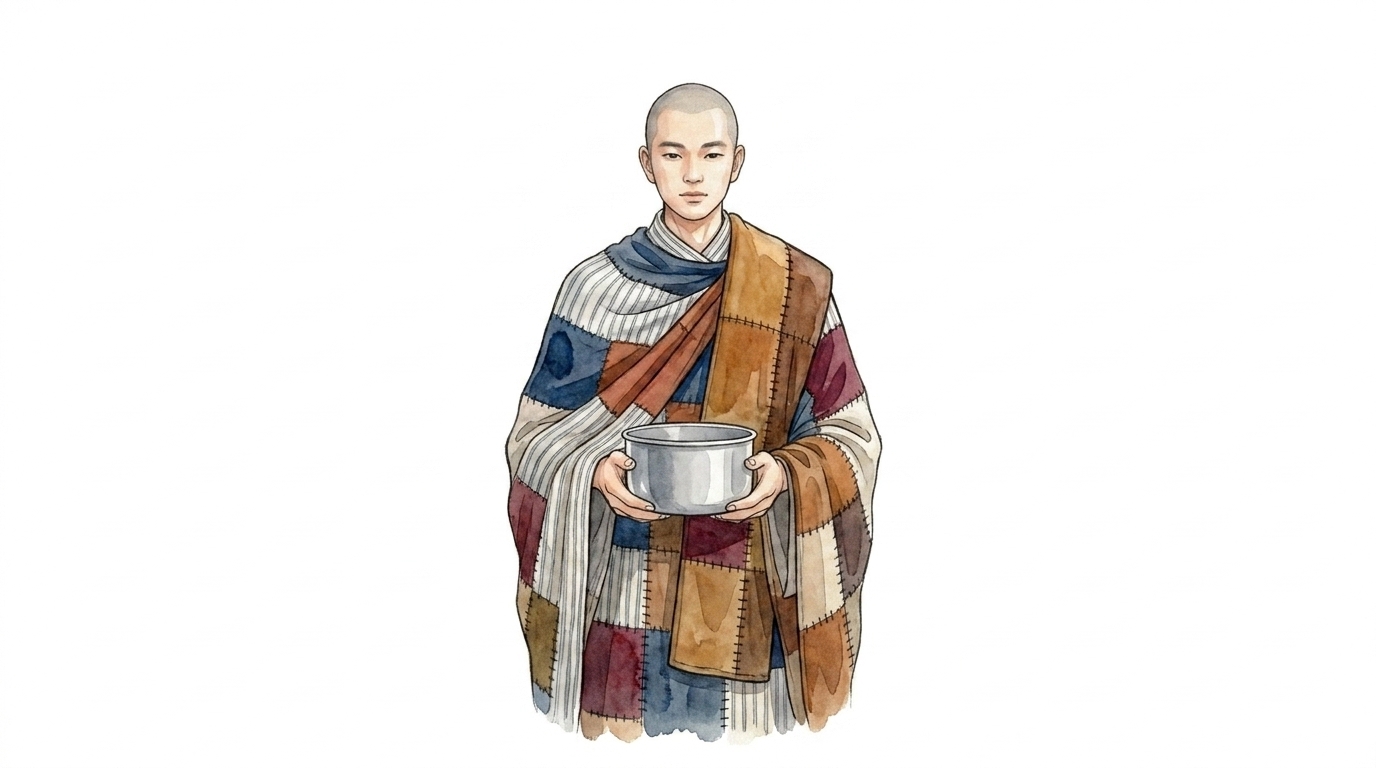
The Triple Robe (three robes) and One Bowl are the minimum possessions the Buddha prescribed for a bhikkhu — a monk who has received full ordination.
This is not a dress code in the ordinary sense. This is a rule about the limits of possession: a monastic is not permitted to own more than these without good reason. Everything beyond them is considered surplus — fertile ground for craving to take root.
The Three Robes – Each with Its Purpose
In the Theravāda tradition, the three robes are:
The First Robe: Antaravāsaka – The Inner Robe (Lower Robe)
This is the robe worn against the body, wrapped around the lower half from the waist to below the knee — similar in function to trousers. It is the closest garment to the body, worn during ordinary daily activities within the monastery.
The Second Robe: Uttarāsaṅga – The Upper Robe
This robe drapes over the left shoulder and wraps around the body, leaving the right shoulder uncovered — the style most commonly seen in photographs of Theravāda monastics. It is worn when going out, meeting lay people, and participating in communal activities or ceremonies.
The Third Robe: Saṅghāti – The Outer Robe (Great Robe)
This is the largest and thickest robe — folded and worn as an additional outer layer for special occasions: entering a city, meeting royalty or officials, cold weather, or reciting during important ceremonies.
The Saṅghāti also carries the greatest symbolic weight — it represents the dignity and virtue of the monastic when engaging with the world.
Three Robes Is Enough – Why No More?
The Buddha designed the triple robe with very practical logic: enough for every circumstance, with nothing extra for craving to feed on. An inner robe for daily life, a middle robe for going out, an outer robe for special occasions and cold. Every circumstance is accounted for — and that is the limit.
When there is nothing more to worry about, no wardrobe to organize, no color or style to choose — a substantial portion of mental energy is freed. This sounds trivial but is not small at all: modern psychology calls this decision fatigue. A monastic with three robes never encounters that problem.
The One Bowl – The Alms Bowl
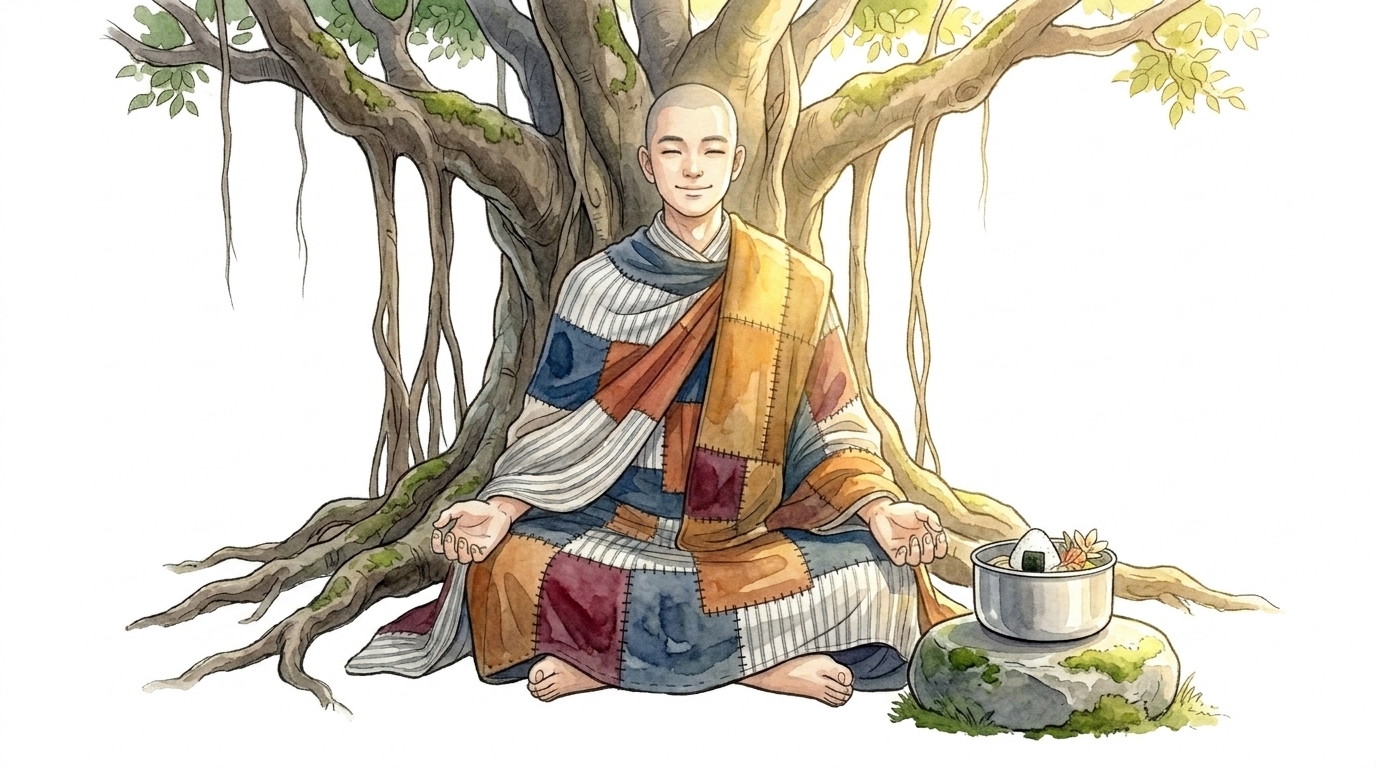
The bowl (pātta) is the fourth and only possession beyond the three robes. It is used to receive food on alms round, and is also the monk’s only eating utensil — no separate plates, cups, or cutlery.
According to the Vinaya, the bhikkhu’s bowl must be made of fired clay or metal — not gold, silver, or precious materials. Its size is also specified: large enough to hold one meal’s worth of food, no larger.
The meaning of the bowl goes far beyond its practical function: it is a symbol of deliberate dependence on the goodness of the world. The monastic who carries the bowl out to the road does so not because there is no other way to eat — but because he has consciously chosen not to provide for himself, so the mind need not be occupied with the business of acquiring food, and can be fully devoted to practice and sharing the Dhamma.
The Spirit of the Triple Robe and Bowl: Intentional Letting Go
The Triple Robe and Bowl are not involuntary poverty. They are a conscious choice to live with the minimum possible — and from that minimum, to discover what is truly necessary for life, and what is merely accumulated habit.
Each time a monastic looks at the three robes and one bowl, it is a reminder: everything else is additional, not essential. Wealth, reputation, status, material comfort — all can be lost without losing what matters most.
This is a practice of letting go at the material level, but its effects reach much deeper into the psychological: when there is nothing left to “protect” or “safeguard,” the mind naturally becomes more open, lighter, and less pulled by worry about the future.
Thich Minh Tue – The Spirit of the Triple Robe and Bowl in the Modern World
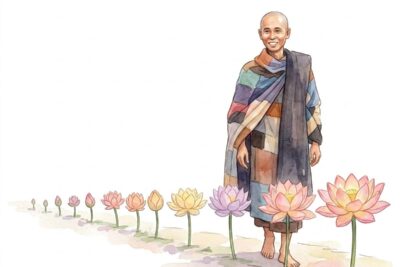
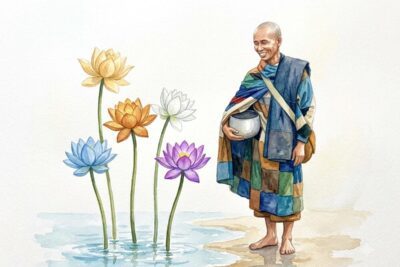
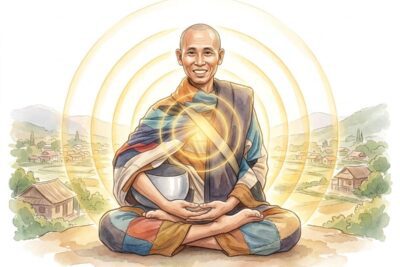
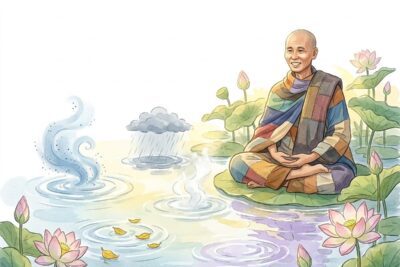
Thay Minh Tue practices the triple robe in the true spirit of the scriptures, but with one very distinctive feature: he does not accept donated fabric — he only gathers scraps of discarded cloth he finds by the roadside, in waste areas, or in deserted places. From those scraps, he cuts and sews the robes himself according to the guidelines of the scriptural tradition — the way each robe is cut, folded, and worn follows the Theravāda form.
These are not haphazard patches. This is the rag-robe practice (paṃsukūlika) at its most thoroughgoing: not only using discarded cloth, but not even accepting fabric from another person’s hands — finding it himself, sewing it himself, not letting anyone provide even a single small piece for him.
To a casual observer, this looks like deprivation. But looked at more closely, it is complete self-sufficiency in letting go: not dependent on the goodness of others even for the one thing most minimal to a monastic’s existence.
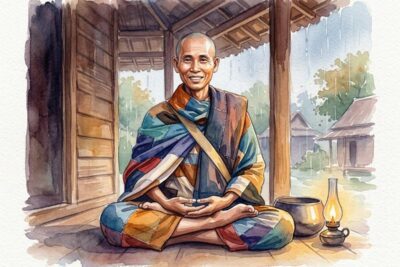
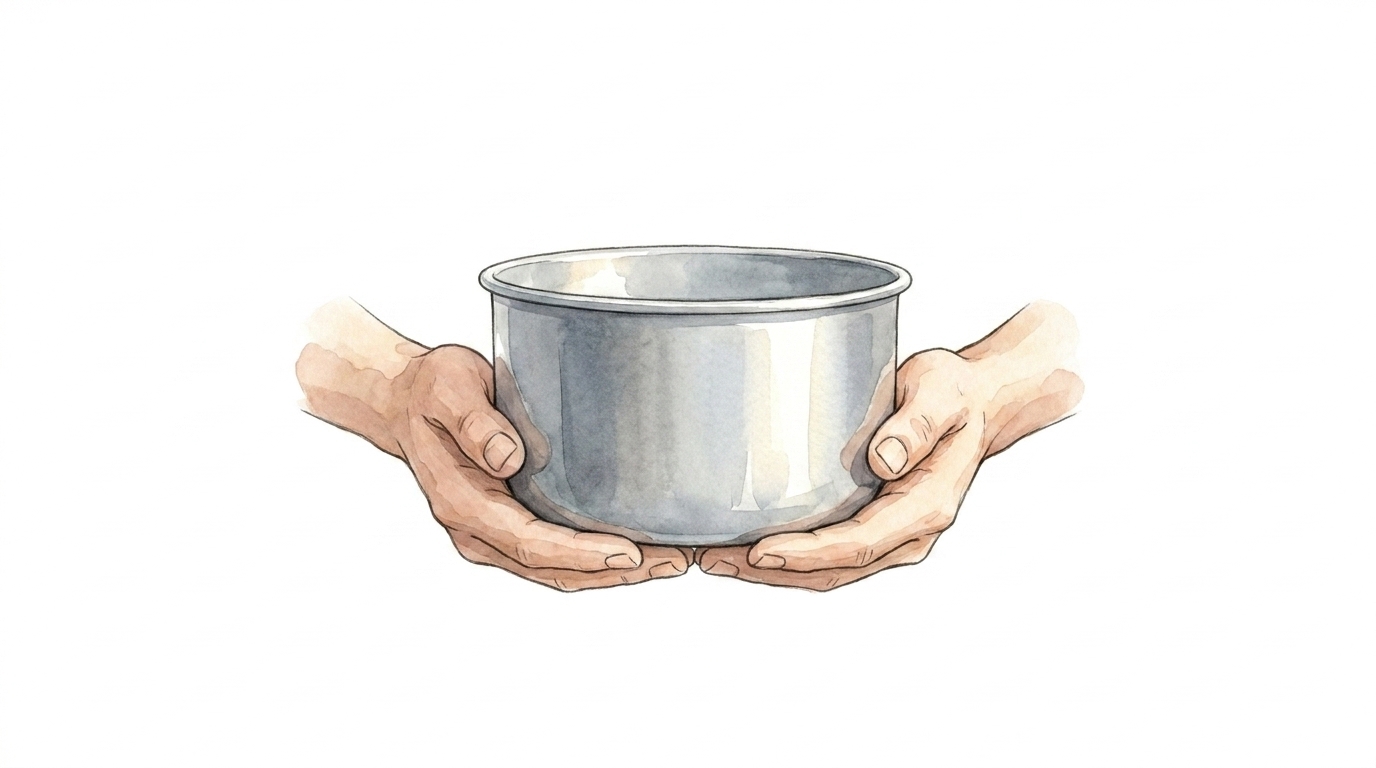
Instead of a traditional fired-clay or metal bowl, Thay uses a plain rimless, handleless aluminum pot. In function, it does exactly what the alms bowl is for: receiving food from those who offer, holding everything in one vessel, without distinguishing fine food from plain.
Someone once asked Thay why he did not use a proper traditional bowl. The spirit of his answer was simple: the pot is what he has, and it is enough. Nothing more is needed.
That is the heart of the Triple Robe and Bowl: not about the specific form of the bowl or the three robes — but about the spirit of this is enough, nothing more is needed.
Not accumulating, not possessing
What makes Thay’s practice closest to the spirit of the Triple Robe and Bowl is not the form of the robes or the pot — but his attitude toward possession in general.
He has no home. No bank account. Accepts no money from anyone. No personal belongings beyond what he carries on his person. Even things people additionally offer — clothing, items — if he has no need of them, he does not keep them.
This is the Triple Robe and Bowl practiced not as a rule to follow, but as a way of life absorbed into every daily decision: do I need this? If not — don’t keep it.
A Lesson for Lay Practitioners
No one is asking you to give up all your possessions and live with three outfits and a single bowl. But the spirit of the Triple Robe and Bowl can be applied at many different scales.
Try once looking honestly at a wardrobe and asking: “Of all this, how much do I truly need?” Not to punish yourself, but to recognize the line between need and want — a line that modern life has done much to blur.
Each time we voluntarily live with a little less — buy a little less, accumulate a little less, worry a little less about “having enough in reserve” — the mind lightens in a way that is hard to explain but very real.
Thay Minh Tue’s plain aluminum pot, above all else, is a reminder of this: “enough” is a state of mind, not a number in a bank account.
Learn more: who is Thầy Minh Tuệ?Biography, the dhutanga practice and the walking pilgrimage.Read more →