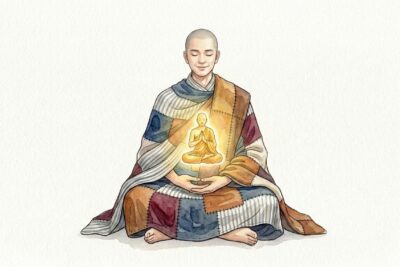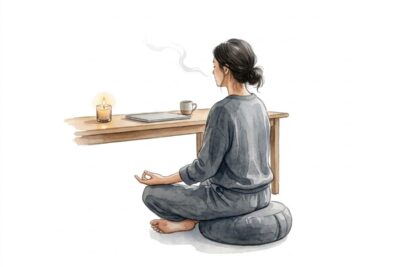
When people hear the word “mindfulness”, they usually picture someone in full lotus posture in a silent meditation hall.
That is a beautiful image — but not a complete one.
The Buddha did not teach mindfulness only for those who owned meditation halls. He taught it for wandering alms-collectors, shepherds, mothers caring for children, weavers at their looms. Anyone who is alive, anyone who is breathing, can practice mindfulness — right inside what they are already doing.
This article is about mindfulness that requires no sitting cushion. Mindfulness while eating. While washing dishes. While walking. While talking. While falling asleep.

What Mindfulness (Sati) Actually Means
Sati — the Pāli word — is usually translated as “mindfulness”. Its root meaning: to remember, to notice, to be present.
Mindfulness is not:
— not “emptying the mind”
— not “relaxation”
— not effortful “concentration”
— not merely a stress-reduction technique
Mindfulness is knowing clearly what is happening, as it is happening, without adding or subtracting.
You are drinking water — you know you are drinking water.
You are angry — you know you are angry.
You are walking — you know your feet are stepping.
That simple. And that difficult — because our minds are almost never where our bodies are.
Why Sitting Meditation Is Not Required
In the Satipaṭṭhāna Sutta (MN 10), the Buddha lists the many settings in which one may practice mindfulness of the body:
“When walking, a monk knows: ‘I am walking.’ When standing, he knows: ‘I am standing.’ When sitting, he knows: ‘I am sitting.’ When lying down, he knows: ‘I am lying down.’ … When putting on robes, carrying the bowl, eating, drinking, chewing, tasting, defecating, urinating, walking, standing, sitting, sleeping, waking, speaking, keeping silent — he does so with clear knowing.”
Note: The passage above combines two sections of the Satipaṭṭhāna Sutta (MN 10): the iriyāpatha-pabba (on the four postures — walking, standing, sitting, lying down) and the sampajāna-pabba (on clear comprehension in every action — putting on robes, eating, drinking, relieving oneself, speaking, keeping silent…). The two sections sit next to each other in the sutta but are distinct passages.
There is no line saying “you must sit in meditation to have mindfulness”.
Sitting meditation is one excellent method — it creates a low-disturbance environment where concentration (samādhi) can grow. But it is only the training room. Life is the match.
Someone who sits an hour each morning but spends the other twenty-three hours lost in distraction will not grow much mindfulness.
Seven Daily Activities for Practicing Mindfulness
1. Eating. Before eating, look at the food. Notice the first taste. Chew slowly, knowing that the mouth is chewing. No phone, no TV. Twenty mindful minutes of a meal nourish the mind more than twenty minutes of scrolling news.
2. Drinking. Hold the cup — feel its weight, its temperature. The first sip — know the taste. The water moves from mouth to throat — know it. A full cup takes only a minute, but a minute of actually being alive.
3. Walking. Walk ten minutes a day with attention on the feet. Left foot lifts — know. Left foot lands — know. No podcast, no phone call. This is the simplest walking meditation (cankama).
4. Working. Typing — feel the fingers touch the keys. Driving — know the hands on the wheel, the eyes on the road. Washing dishes — feel the warm water, the soap bubbles, each plate becoming clean.
5. Speaking. Before opening your mouth — pause for one breath. Is what you are about to say true, needed, harmless? Mindfulness in speech is protection against a thousand future regrets.
6. Listening. When another person speaks — really listen, not rehearsing your reply. Mindful listening is the greatest gift you can give the person in front of you.
7. Sleeping. Before sleep, lie still for five minutes, breathe naturally, know the breath. No scrolling. A mindful evening leads to a peaceful morning.
Each of these seven is not a “new activity” you must add to a full day — they are activities you already perform. Mindfulness only changes the quality of the doing, not its content. A single mindful meal, over years, gently rewires the relationship between mind and body. And when several activities are practiced together — mindful eating followed by mindful washing followed by mindful walking — the day itself becomes a continuous thread of clear knowing, without a single extra minute spent.
Signs That Mindfulness Is Growing
Practitioners often ask: “How do I know I am making progress?” The signs are usually quiet, not dramatic.
Shorter gap between reaction and awareness. Before practice, anger arises and ten minutes later you notice you were angry. After some months, the gap shrinks — you notice within one minute, then within a few seconds. Eventually, awareness and the arising of a feeling are almost simultaneous. That closing gap is mindfulness maturing.
Less identification with thoughts. You still have anxious thoughts — but you now see them as thoughts rather than as reality. “There is anxiety” replaces “I am ruined.” The words look similar; the inner distance is enormous.
Small pleasures return. The taste of warm rice. The feeling of clean water on the hands. The sound of rain at night. These pleasures were always available; only distraction hid them. Mindfulness gives them back.
Fewer regrets by evening. Because words were weighed before speaking, and actions were noticed while acting, the ordinary residue of “I shouldn’t have said that” thins out. A quiet mind at bedtime is a reliable sign of a day lived with sati.
Master Minh Tuệ — Every Footstep a Teaching
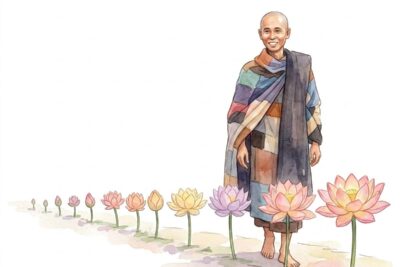
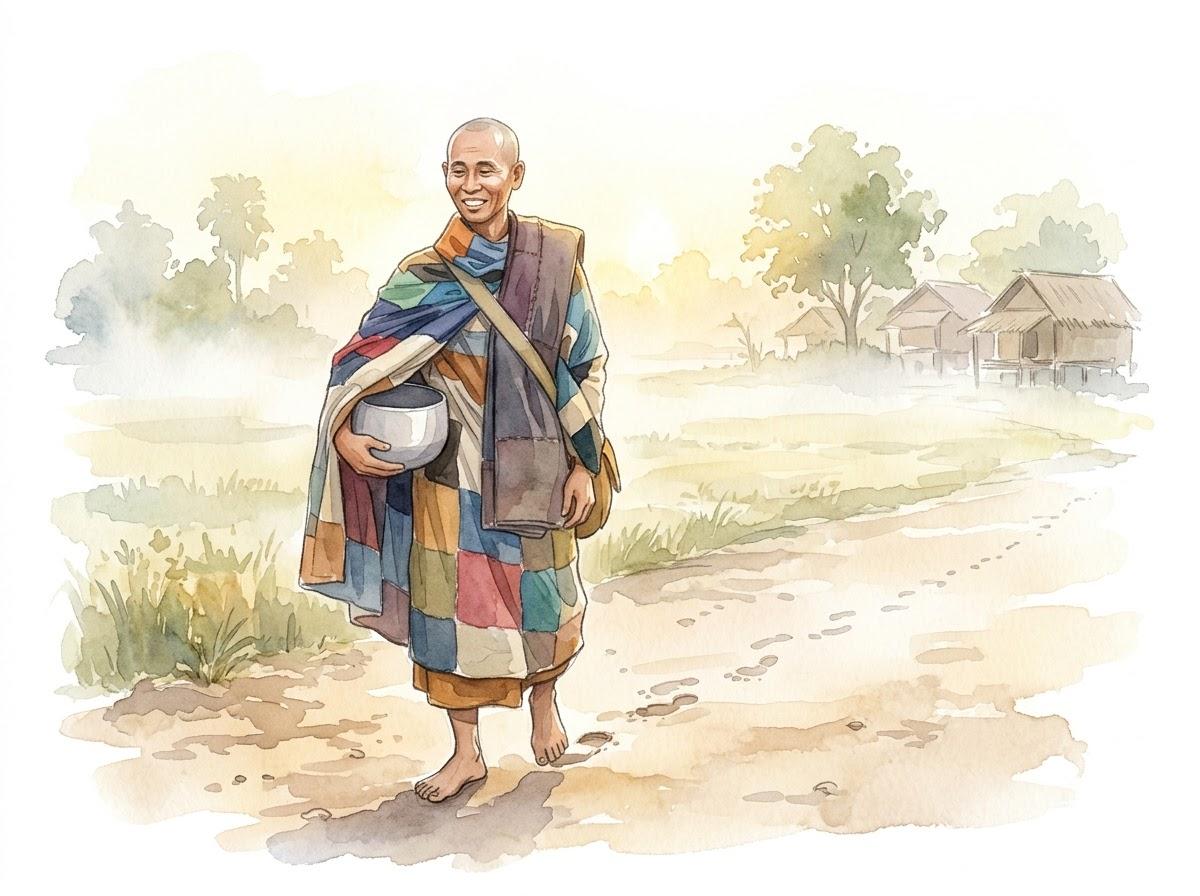
Watching Master Minh Tuệ walk, one sees that mindfulness is not a lecture — it is a way of being.
He wears no earphones. Makes no phone calls. Reads nothing as he walks. He simply walks — and knows he is walking.
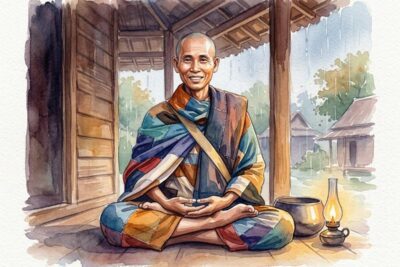
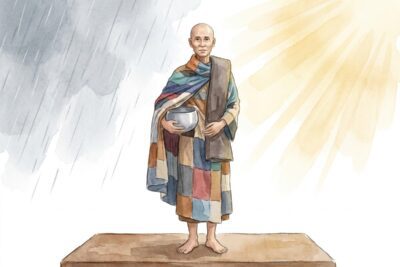
When receiving alms, he stands still to accept food. Once the bowl is full, he stops. He does not pick out favorites. He does not refuse what is offered. He knows — that is mindfulness in receiving.
When eating, he eats by the roadside or in a cemetery. One meal a day. When finished, he washes and stores the bowl. He knows each motion — that is mindfulness in eating.
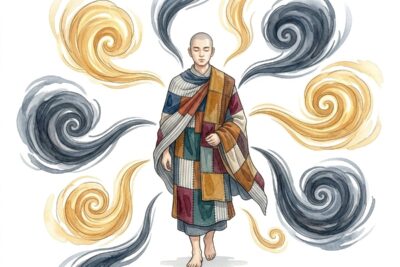
When insulted, he is silent. When praised, he is equally silent. Feeding no reaction — that is mindfulness at the moment of contact (phassa).
The entire twenty-four hours become one long meditation, with no separation between “practice time” and “rest time”.
Note: This analysis is based on observable behavior, not Master Minh Tuệ’s own words about his inner experience.

Common Misunderstandings
Confusing mindfulness with “slowness”. Many assume mindfulness means doing everything at a crawl. It does not. Mindfulness is clear knowing — whether you are sprinting or standing still. A top tennis player is intensely mindful, though each stroke lasts a fraction of a second.
Confusing mindfulness with a “relaxation technique”. Mindfulness is not always pleasant. Sometimes you know clearly that you are anxious, that you are in pain — and that is correct mindfulness too. Not to “stop the anxiety”, but to not be carried away by it.
Confusing mindfulness with “no thinking”. The mind cannot stop thinking. Mindfulness is knowing you are thinking — not forcing the thoughts to cease.
Waiting for ideal conditions. “When I’m less busy, I’ll start practicing.” You will never be less busy. Practice while you are busy — that is daily-life mindfulness.
Starting in Seven Days
Days 1–2: Choose one daily activity — brushing teeth in the morning, say. For those three minutes, only brush and know you are brushing. Nothing else.
Days 3–4: Add a second activity — breakfast. Eat without your phone.
Days 5–6: Add ten minutes of walking meditation. Slow steps, awareness on the feet.
Day 7: Look back. How many minutes were you actually present this week? Note it, without self-blame.
After seven days, add a new activity. Continue like this — after three months, mindfulness becomes part of how you live.
Mindfulness and the Rest of the Path
Mindfulness does not stand alone. It is the entry point into the entire system of practice.
Without mindfulness — no clear seeing of impermanence in the breath.
Without mindfulness — no holding of precepts (sīla) under temptation.
Without mindfulness — no recognition of the five hindrances as they arise.
The Buddha called mindfulness “the king of qualities” — because everything begins there. See also the foundational teaching of the Four Foundations of Mindfulness for how sati extends across the four domains: body, feelings, mind, and phenomena.
Frequently Asked Questions
How does mindfulness differ from concentration?
Concentration (samādhi) is narrow attention on a single object, often with effort. Mindfulness (sati) is clear knowing of what is happening — possibly across many objects, relaxed but alert. Concentration is a flashlight; mindfulness is daylight.
Do I need to belong to a religion?
No. Mindfulness is a natural human capacity. Buddhism teaches a systematic method to develop it, but anyone can practice — no change of faith required.
Can children practice?
Yes, and beautifully. Children learn mindfulness through play — listening to a bell, breathing with a stuffed animal on their belly, walking slowly around the house. Start with three to five minutes a day.
How can someone working twelve-hour days practice?
The busiest people need mindfulness the most. No extra time is required — convert existing activities (commuting, eating, showering) into practice moments. Zero extra minutes.
How long until I see results?
First week — you notice how often you were not present. That already is progress (before, you did not know you were absent). After a month — fewer impulsive reactions. After three months — a lighter mind when difficulties arise. Mindfulness does not promise fast, but it promises steady.