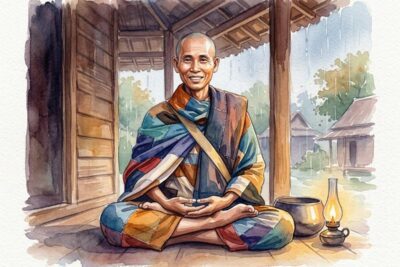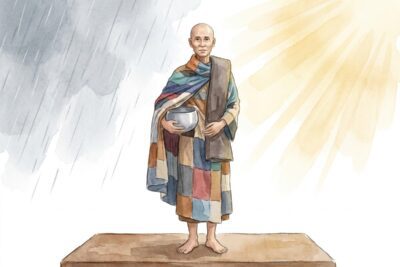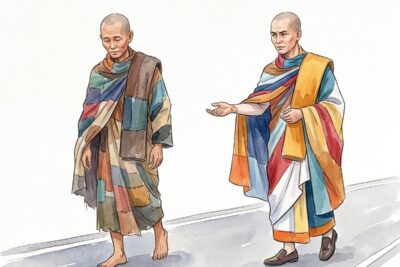
On social media, every time someone criticizes a monastic whom many admire, one comment reliably appears: “That person is a reverse bodhisattva, sent to help the master’s practice.”
The phrase sounds beautiful. But sit with it, and questions arise. Does a “reverse bodhisattva” truly exist? Who has the authority to call another person one? If anyone who slanders or wounds is a “reverse bodhisattva”, where does the line between wholesome and unwholesome remain?
The concept is real within the Buddhist tradition. Yet it is also one of the most misused ideas in contemporary conversation — pressed into service to justify precept-breaking, or to spread a veneer of piety over matters that should be named otherwise. This article clarifies the two meanings, marks the line that must not be crossed, and returns the concept to its proper place.
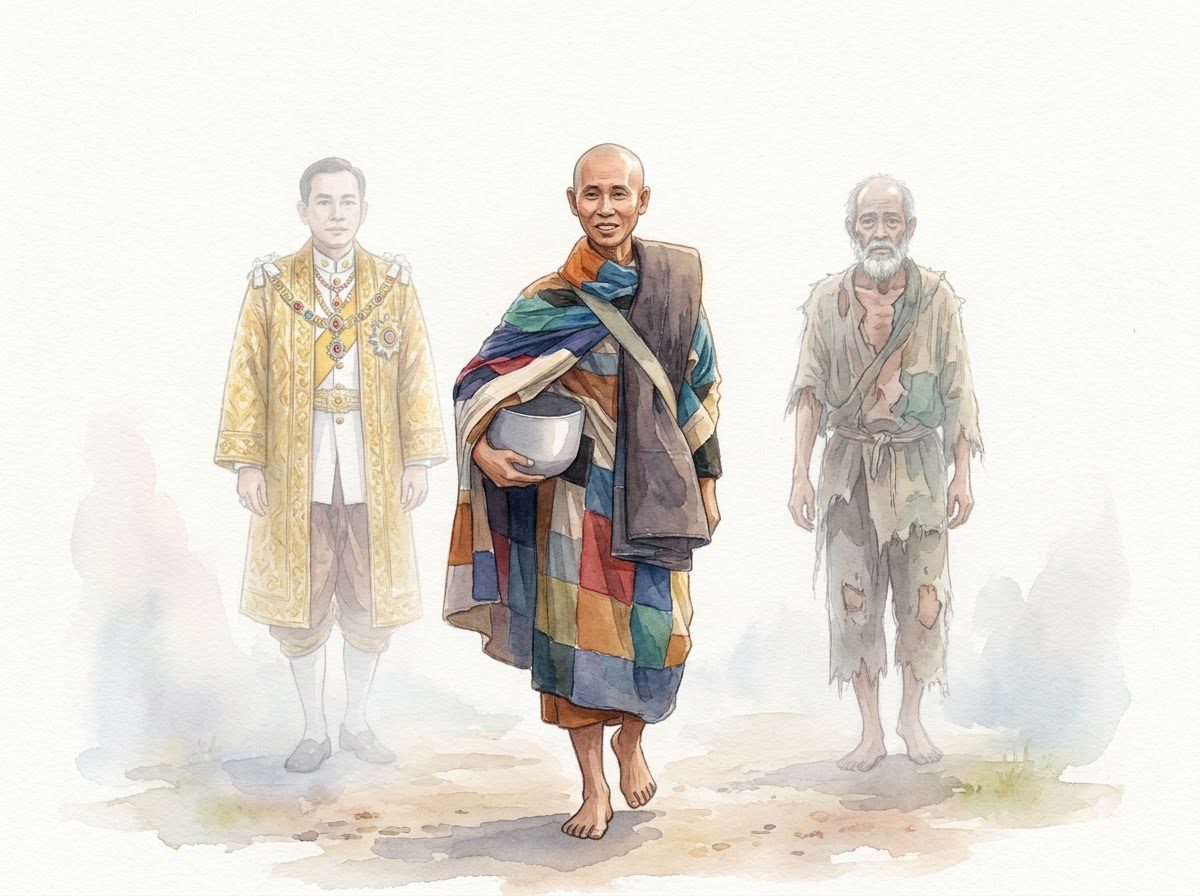
What Is a Reverse Bodhisattva?
The term carries two quite different meanings.
Meaning A — Reverse Practice or Paradoxical Conduct. The classical Mahāyāna sense. A bodhisattva of ripened wisdom deliberately appears in a form-breaking manner — perhaps eating meat, drinking wine, acting against social expectation — to help beings drop attachment to outward form and see the marrow of the Dharma. Inside first illumined, only then outside dares to break form.
Meaning B — Adverse-Circumstance Bodhisattva. The popular contemporary reading. It refers to people who confront, criticize, or trouble us — those who look like adversaries — whose obstruction becomes an opportunity to cultivate patience and mindful observation.
The two overlap around the word “reverse”, but their subjects differ. Meaning A speaks of a practitioner actively manifesting; Meaning B speaks of an outside party serving as supportive condition. Precisely this overlap is where misuse happens: people take the light of Meaning A (a genuine bodhisattva, genuinely breaking form) and drape it over Meaning B (anyone at all who criticizes becomes a “bodhisattva”).
Reverse Practice: The Mahāyāna Origin
The theoretical foundation for paradoxical conduct is the Mahāyāna teaching of skillful means (Sanskrit: upāya-kauśalya). The Lotus Sutra (Sanskrit: Saddharmapuṇḍarīka Sūtra) devotes an entire chapter to it. The core idea: one endowed with great wisdom and great compassion may temporarily employ methods that depart from the usual path, provided the final aim remains liberation. The sutra’s famous image is the father who promises his children carts to lure them from a burning house — on the surface a broken promise, in intent a rescue.
Reverse practice is a form of skillful means. The bodhisattva manifests in a form-breaking manner not to indulge personal preference, but to shatter fixed views — to show that the Way lies not in outward appearance, but in whether the mind has awakened.
The scriptures attach very strict conditions. There must be perfection of wisdom (Sanskrit: prajñā) as the ground, great compassion (Sanskrit: mahākaruṇā) as the motive, and the action must actually lead others toward liberation. Missing any of these, skillful means collapses into precept-breaking.
Three Classical Figures of Reverse Practice
Three figures are typically named — each embodying a different mode.
Vimalakīrti. The central figure of the Vimalakīrti Sūtra (Sanskrit: Vimalakīrti Nirdeśa Sūtra) — a Mahāyāna text emerging in India around the first to second century CE. A lay householder with wife and children, yet the sutra portrays his wisdom as equal to that of the great bodhisattvas. He enters gambling houses, wineshops, and brothels — but to transform those he meets there, not to indulge. Outwardly “breaking form”, inwardly not the slightest defilement.
Ji Gong. A historical monk of the Southern Song dynasty, roughly 1130 to 1207. Folk tradition depicts him as a monk who ate meat and drank wine, wore ragged robes, behaved wildly — yet possessed supernatural powers, aided the poor, and rebuked wrongdoers. It must be said plainly: the Ji Gong of popular novels is heavily mythologized, far larger than the historical record. Even so, the story became a symbol for one idea: the Way is measured not by the robe or the vegetarian bowl, but by whether the mind is illumined.
Budai. A monk of the late Tang and early Five Dynasties period, who passed around 917 CE. Round-bodied, always laughing, carrying a large cloth sack — hence his name. The Mahāyāna tradition regards him as an incarnation of the future Buddha Maitreya; the pot-bellied laughing figure at many temple gates is modeled on him. His “reverse” is not precept-breaking, but the overturning of the solemn image people habitually attach to a sage — teaching that the Way is present also in laughter and lightness.
These three are the highest expressions of reverse practice — the bar for anyone to be called such a figure is extraordinarily high.
The Adverse-Circumstance Bodhisattva: The Popular Reading
Here, “reverse bodhisattva” designates the people and events outside us — the critic, the disrupter, the one who causes harm — whose opposition becomes the occasion for our inner training. The intuition holds a partial truth: the practitioner can transform any circumstance into a field of training. Theravāda speaks of mindfulness with feelings arising under difficulty; Mahāyāna speaks of contemplating adverse conditions as favorable ones.
But a quiet shift has taken place in usage: from “I transform adverse circumstances into practice” (speaking of oneself, in humility) to “that person is my reverse bodhisattva sent to help me” (bestowing a title on another). The step is small; the consequences are large.
Warning: When the Concept Is Misused
This is the most important section. Several signs indicate misuse.
One — used to justify harmful acts. “That person slandered me, but they are a reverse bodhisattva; indeed I should be grateful.” Sounds pious, but it quietly erases the line between wholesome and unwholesome. The one who harms still generates unwholesome karma by their own volition. Our transforming adversity into practice does not turn them into a “bodhisattva”. Two independent matters.
Two — labeling serious precept-breakers as bodhisattvas. When a person bearing the outer form of a monastic breaks major precepts — indulgence, sexual conduct, misappropriating property — and supporters rush to defend them as “manifesting the paradoxical conduct of Vimalakīrti or Ji Gong”, great caution is required. Vimalakīrti entered a brothel with an undefiled mind — a claim only a fully awakened one can verify. The precepts, by contrast, can be observed. Using what cannot be verified (inward awakening) to override what can be observed (outward transgression) inverts the order of evidence.
Three — used to dodge responsibility. “I act this unusually because I am practicing paradoxical conduct.” A convenient amulet — freedom to do as one pleases, plus a pious halo. The ancient masters warned: the one who truly has the practice does not proclaim themselves a paradoxical bodhisattva. Vimalakīrti did not call himself one. Budai did not stamp the label on his forehead. Self-labeling is more often than not a sign the practice has not ripened.
Four — minimizing genuine harm to victims. Sometimes the label runs the other way. “Your husband treats you that badly? He must be your reverse bodhisattva” — sounds like consolation, but walks around the problem. Domestic violence and real injury should not be repackaged under a spiritual-sounding name. The one who has been hurt needs to hear they may protect themselves — not that the one hurting them is a “bodhisattva” aiding their practice.
Five — casually labeling anyone who criticizes a revered teacher. Online, whenever someone voices criticism of an admired monastic, a common reflex is to name that critic a “reverse bodhisattva”. Two problems follow. First, no one — however devout — has the authority to confer the title. Second, the labeling lends a pious glow to legitimate criticism and baseless slander alike, so outsiders can no longer tell reasoned questioning from personal attack.
How the Theravāda Tradition Sees This Concept
Theravāda Buddhism does not use the term “reverse bodhisattva”. The concept is specifically Mahāyāna. In the Pāli Nikāya collections, no discourse describes bodhisattvas manifesting precept-breaking to teach, nor is the phrase employed for those who create adverse conditions.
The Theravāda view of karma is direct. The Aṅguttara Nikāya 6.63 — the Nibbedhika Sutta — offers the classical formulation: the Buddha teaches, in substance, that volition (Pāli: cetanā) is karma; through volition one acts by way of body, speech, and mind. The volition of the one who acts determines the quality of the karma — not the interpretation placed upon the action by others.
This bears on the “reverse bodhisattva” concept. The person who causes us harm, however kindly we view them as a “condition for practice”, still bears the unwholesome karma of their intention. The Majjhima Nikāya 135 — the Cūḷakammavibhaṅga Sutta (Shorter Analysis of Action) — moves along the same line: differences in health and longevity flow from each person’s own past karma of body, speech, and mind.
Within the Theravāda frame: one who acts harmfully still bears unwholesome karma — they are not a “bodhisattva”. We may cultivate equanimity and letting-go, mindfulness, and freedom from ill will — this is our own work. Calling them a “bodhisattva” to console ourselves is not the Theravāda approach.
This is not a Theravāda rejection of Mahāyāna. The two traditions carry different vocabularies, and the Mahāyāna spirit of skillful means has genuine value when kept in place. What Theravāda simply does not follow is the misuse — a misuse serious Mahāyāna masters have themselves long warned against. See also Theravāda and Mahāyāna Buddhism.
Applying the Spirit Rightly: Transforming Adversity Into Practice
Setting aside the misuse, the real core of value lies here: the practitioner can turn any circumstance into a field for training the mind. But the accurate way to say this is: I transform adversity into practice — not “that person is my reverse bodhisattva”. The subject of the transformation is oneself.
Mindfulness with praise and blame. Praise arrives, and is known as praise. Blame arrives, and is known as blame. One does not swell under praise, nor shrink under blame. Both are conditions arising and passing.
Equanimity under opposition. When someone stands against us, the mind’s habit is to raise two sides. The practice is to notice the very raising, and see both sides as flows of dependent origination. Equanimity does not erase right and wrong; it only ceases to cling to the difference as if absolute.
Do not wait for adversity to begin practicing. Mindfulness must be trained during quiet times, so that when adversity comes it is already a tool at hand — not something borrowed hastily in crisis.
Their karma, our mind. The one who harms bears their own karma; we bear our own. Keep mindfulness so as not to generate unwholesome karma; do not confer a teaching role on someone who is simply generating their own.
Master Minh Tuệ and the Adverse Circumstances Along the Path
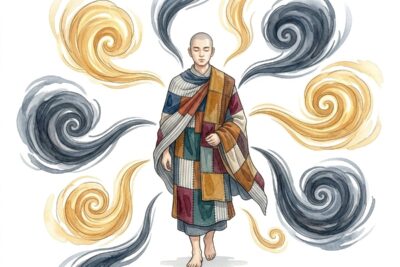
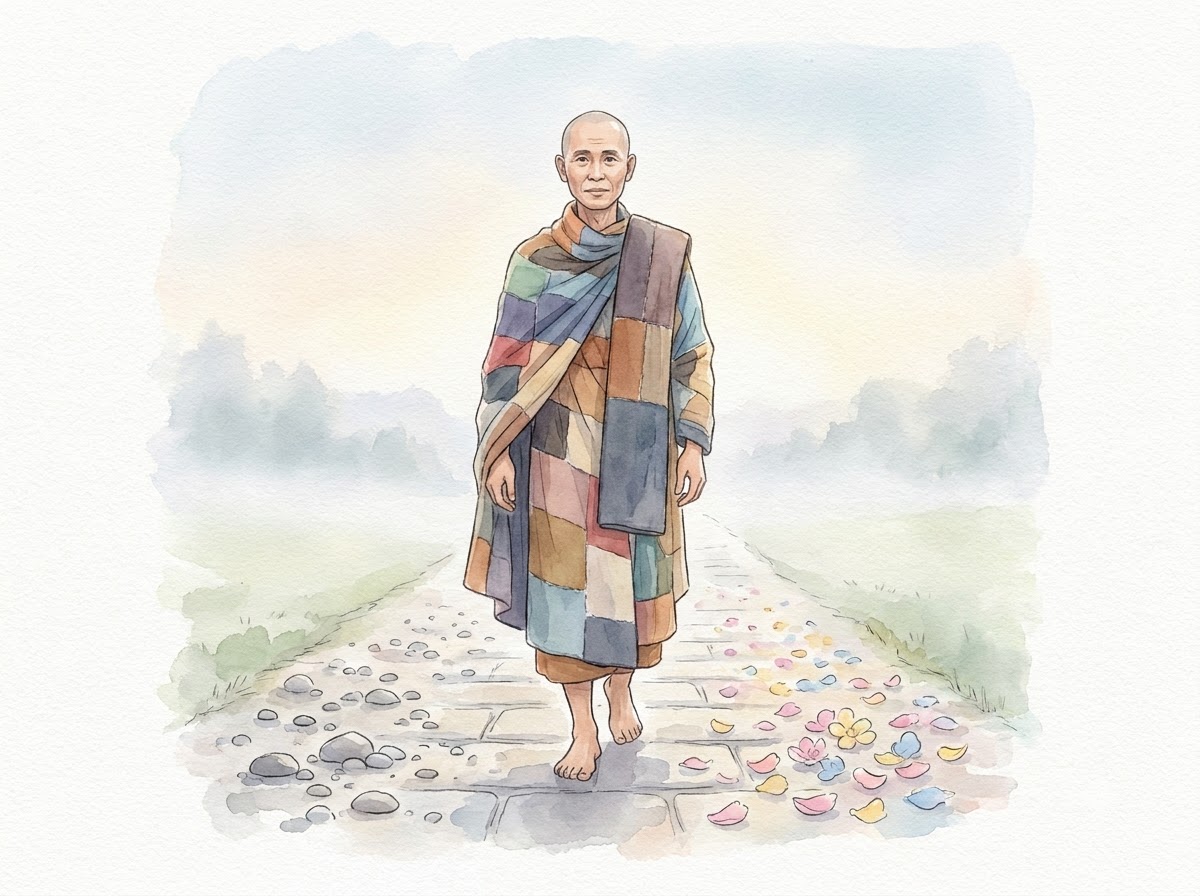
The alms-walking journey of Master Minh Tuệ, observed from outside, has passed through many stretches of adverse circumstance — crowds pressing close in veneration until the way was blocked; bitter words and slander online; public criticisms from various directions.
Across all these stretches, the publicly visible record shows the Master keeping a consistent outward response: he does not step out to defend himself. He does not stop to argue. He does not issue corrections when slander is spread. He continues to walk, continues to keep the dhutaṅga austerities, continues to receive alms only for a single meal.
In various public videos, Master Minh Tuệ has spoken in essence: everything comes from causes and conditions, from karma; the practitioner’s work is only to keep the precepts and cultivate well, with no need to hold resentment. This framing is Theravāda in flavor — it does not cast critics as a “reverse bodhisattva”, nor treat them as enemies.
An important clarification: this article does not designate any specific person — not stone-throwers, not critics, not slanderers — as the Master’s “reverse bodhisattva”. To do so would exceed our authority. Only a fully awakened being can verify who is a bodhisattva; ordinary readers cannot confer such a title.
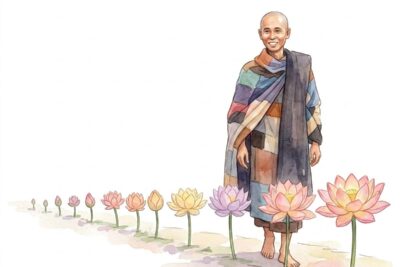
What we can describe is the Master’s observable conduct — walking past praise without pausing, walking past blame without turning to defend, walking the same barefoot pace whether the road is strewn with flowers or with dust. We do not speculate about the inner experience of those who created the adverse conditions. They are human beings generating their own karma of body, speech, and mind.
If there is anything to draw from the way the Master walks through adversity, it is this: the practitioner does not need to drape a pious title over an adversary to keep the mind steady. Keeping the precepts, keeping mindfulness, continuing to walk — that is enough.
Note: This is analysis based on observable behavior, not the Master’s own words about his inner experience.
Frequently Asked Questions
Do reverse bodhisattvas really exist?
Yes, within the Mahāyāna frame. The Vimalakīrti Sūtra, Ji Gong, and Budai are long-standing parts of the tradition. But “existing” does not mean anyone who behaves a little unusually is one. The scriptural bar is high: perfection of wisdom and great compassion must be present. Theravāda does not use the concept at all.
Are people who criticize or slander me actually “reverse bodhisattvas”?
It is unwise to assign such a title quickly. No ordinary person has the authority to confer the title “bodhisattva” on another. Per the Nikāya teaching on karma, whoever intends harm bears the unwholesome karma of that intention — whether we view them as a “condition for practice” or not. The more accurate framing: “I am transforming this adversity into practice”, rather than placing a label on them.
Does the Pāli Canon mention reverse bodhisattvas?
No. The concept belongs specifically to Mahāyāna. The Nikāya collections speak plainly of karma — in the Aṅguttara Nikāya 6.63, the Majjhima Nikāya 135, and elsewhere — and nowhere describe bodhisattvas manifesting precept-breaking as a means of teaching.
Can I claim to be a “reverse bodhisattva” myself to justify unusual conduct?
A warning sign. The figures held up as embodiments of paradoxical conduct — Vimalakīrti, Ji Gong, Budai — did not label themselves in this way. Reaching for the label to justify one’s own irregular behavior is more often than not using the concept as a shield for precept-breaking. Serious Mahāyāna masters have consistently cautioned against this self-deception.
What separates authentic paradoxical conduct from an excuse for breaking precepts?
In authentic paradoxical conduct, the practitioner does not self-proclaim, derives no personal gain, produces concrete transformation in others toward liberation, and keeps the inward mind undefiled. In precept-breaking dressed as paradoxical conduct, the person self-proclaims, extracts personal gain (money, fame, power, indulgence), transforms no one, and the mind is plainly attached. When the distinction is hard to draw, the safest measure is the yardstick of the precepts — they can be observed, whereas inward awakening cannot.