There is a question many people ask when they first encounter Buddhism: “I’m not a monk, I’m not ordained — so what does practicing the Dhamma mean in ordinary daily life?”
The shortest answer is: start with the Five Precepts.
These five precepts are not a list of prohibitions. They are five life commitments — when upheld, they make your life and the lives of those around you lighter, more trustworthy, and more meaningful. They are also the foundation without which all higher spiritual practice is like building a house on sand.
The Five Precepts Are Not External Rules
Before going through each precept, there is one important thing to understand: the Buddha was not a lawgiver.
When he taught the Five Precepts, he did not say “follow these because I say so” or “violations will be punished.” He simply pointed out: these actions cause harm — first and foremost to the person who commits them, then to those around them, and ultimately to society at large.
Keeping precepts in Buddhism is a voluntary act arising from understanding — not from fear, not from wanting praise, but from clearly seeing the consequences of breaking them and the benefits of keeping them.
This means: two people can both avoid lying, but one avoids it from fear of punishment and the other avoids it because they understand that lies destroy trust and cause harm — those two people are practicing at very different levels.
The Five Precepts – Their True Meaning
The First Precept: Not Killing
“I undertake the training rule to refrain from taking life.”
At the simplest level: not killing people, not killing animals.
But the deeper spirit is nurturing respect for life — recognizing that every living being has feelings, wants to live, fears death and pain. Life does not belong only to humans.
For lay practitioners, keeping this precept fully in the absolute sense is difficult — many people eat meat, many livelihoods involve the use of animals. Buddhism does not demand immediate perfection. What matters more is cultivating a mind that does not want to cause harm: beginning with not killing what is unnecessary, not encouraging cruelty, and gradually extending compassion to more and more beings.
Those who practice this precept well gradually develop mettā (loving-kindness) — the wish for all beings to be happy. This is the foundation of unconditional love.
The Second Precept: Not Stealing
“I undertake the training rule to refrain from taking what is not given.”
Stealing in its simplest form is taking another’s property without permission. But the scope of this precept is much wider in everyday life:
Cheating at work. Using work time for personal tasks without disclosure. Not returning extra change when a seller makes an error. Copying creative work without attribution. Using authority to claim benefits one does not deserve.
All of these are variations of “taking what is not given” — violating the spirit of the second precept even though no one calls it “stealing.”
Those who practice this precept well develop contentment (santuṭṭhī) — knowing enough, not craving what does not belong to them. This is the foundation of inner peace in a world full of material temptation.
The Third Precept: Not Engaging in Sexual Misconduct
“I undertake the training rule to refrain from sexual misconduct.”
For lay practitioners, this refers to not betraying commitment in a relationship — no infidelity, no sexual conduct that causes harm to others or to oneself.
The deeper spirit is respecting the trust in intimate relationships. When sexuality is used to dominate, deceive, or satisfy desire at the expense of another person’s feelings — that is when the third precept is broken in its deepest sense.
Those who practice this precept well create an environment of trust in family and relationships — the foundation for both themselves and those close to them to feel genuinely safe and able to grow.
The Fourth Precept: Not Lying
“I undertake the training rule to refrain from false speech.”
This is the precept with the widest impact on social life and also the one most directly connected to Right Speech in the Eightfold Path.
Not lying encompasses the four kinds of harmful speech the Buddha identified:
False speech — saying what is untrue, fabricating. The most obvious form.
Divisive speech — speaking one way to one person and differently to another, sowing division. Many people don’t consider this “lying,” but its harm is no less.
Harsh speech — words that are crude, insulting, causing pain through language. Words can leave wounds that heal more slowly than physical injuries.
Idle chatter — speaking about nothing useful, pointless conversation that wastes the time and energy of both parties.
Keeping the fourth precept means more than “not making things up” — it means treating speech as something with real power to create or destroy trust, connection, and peace.
The Fifth Precept: Not Using Intoxicants
“I undertake the training rule to refrain from intoxicants that cloud the mind.”
This is often the most debated precept in modern society, where alcohol is a common part of social culture.
The Buddha did not establish this precept because alcohol is “evil” in some absolute sense. He established it because alcohol and intoxicants weaken mindfulness — and when mindfulness weakens, the likelihood of breaking the other four precepts increases significantly.
This is the precept that protects the others. Many harmful actions — violence, deception, betrayal — happen when a person is no longer fully alert. Keeping the fifth precept is keeping the foundation of mindfulness intact so the other four can be held with stability.
What Does Keeping the Five Precepts Bring in Practice?
When the Five Precepts are kept seriously — not perfunctorily or for appearances — life changes in very concrete ways:
A lighter mind. Nothing to hide, no lingering regret, no fear of being found out. Cleanliness in action creates a lightness of mind that nothing else can replace.
Greater trustworthiness. Someone who keeps the Five Precepts becomes a person those around them know they can rely on. In a world where trust grows increasingly rare, this is a profound asset.
Foundation for meditation. As discussed in the Ethics–Concentration–Wisdom article: only a mind clean in its precepts can settle deeply in meditation. Without Ethics, Concentration will always be thin and unstable.
Acting from love, not from rules. With long practice, the Five Precepts are no longer a list of “must do, must not do” — they become a natural way of living arising from genuine understanding and love for oneself and others.
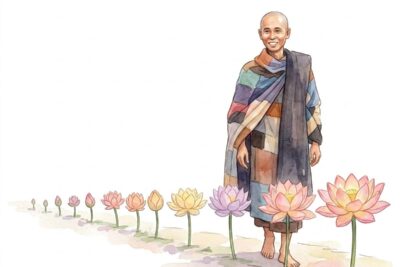
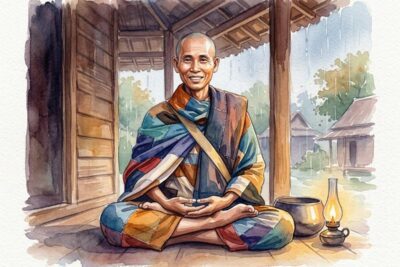
Thay Minh Tue – The Five Precepts Lived, Not Read
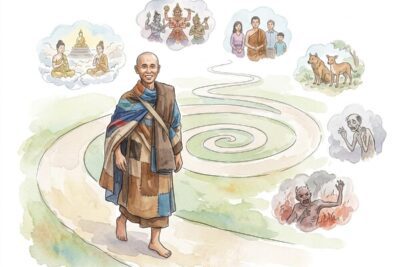
Thay Minh Tue does not keep the Five Precepts — he keeps the 227 bhikkhu precepts of the Theravāda tradition, which include and far exceed the Five Precepts in every dimension. But looking at the Five Precepts, we can see how clearly they are present in his every action.
Not killing — He does not harm any living creature, however small — not an ant, not a mosquito. Not from fear of breaking a rule, but because compassion for all beings has become the way he sees the world.
Not taking what is not given — He accepts no money, accepts nothing that is not actively offered. Even when people insist on pressing money into his hands, he firmly declines. This is the second precept kept at a thoroughgoing level that is rarely seen.
Not sexual misconduct — He maintains complete celibacy according to the bhikkhu precepts, avoiding unnecessary physical contact with anyone. Not coldness — but a clear and respectful maintenance of precept boundaries.
Not lying — Perhaps this is what people notice most clearly when they hear Thay speak. He speaks no empty pleasantries. When he doesn’t know, he says he doesn’t know. When he’s not certain, he says so. His words carry weight because they are always what he genuinely thinks and knows — nothing added, nothing omitted, nothing embellished.
Not using intoxicants — Natural to his way of life: no alcohol, no tobacco, nothing that dims awareness. This is not harsh discipline — it is the natural consequence of someone who considers wakefulness the most precious thing worth protecting.
Looking at Thay Minh Tue, the Five Precepts are no longer theory on a page. They are something completely liveable — not easy, not without effort, but entirely possible — by an ordinary human being who chose to walk that path.
Where to Begin?
There is no need to keep all five fully and perfectly from day one. The Buddha did not teach immediate perfection — he taught sustained effort and honest self-awareness.
A practical way to start: choose the one precept you feel you break most often and bring conscious attention to it for one month. Don’t judge yourself when you slip — just notice, understand why, and continue.
Over time, each precept is kept not through effort but because you have become that person — someone for whom causing harm, deceiving others, or taking what isn’t theirs simply no longer fits with who they want to be.
That is when the Five Precepts truly enter your life.
Learn more: who is Thầy Minh Tuệ?Biography, the dhutanga practice and the walking pilgrimage.Read more →