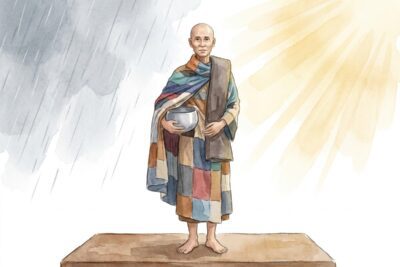
You sit down to meditate. You close your eyes. Within five minutes — the mind is already full.
Remembering the morning’s coffee. Replaying yesterday’s argument with a colleague. Drowsiness. An itch, a shifted posture, another shift. Then doubt: “Is this practice even doing anything?”
These are the five hindrances — nīvaraṇa — the five great obstacles that every meditator, from beginner to veteran, must confront.
The Buddha placed particular emphasis on these, because until they are recognized and countered, the mind cannot settle enough to see the truth.
What Are the Five Hindrances?
Nīvaraṇa means “that which covers” or “that which obstructs”. In Buddhist psychology, these are the five mental states that block concentration (samādhi) and wisdom (paññā) from arising.
The five:
1. Kāmacchanda — sensual desire.
2. Byāpāda — ill-will.
3. Thīna-middha — sloth and torpor.
4. Uddhacca-kukkucca — restlessness and remorse.
5. Vicikicchā — doubt.
These are not five separate essences. They are five tendencies of mind — arising in turns throughout daily life, and standing out especially clearly during meditation.
In the Great Discourse on the Foundations of Mindfulness (DN 22 — Mahāsatipaṭṭhāna Sutta), the Buddha placed the five hindrances at the very beginning of contemplation of mental objects (dhammānupassanā) — instructing the practitioner to know when a hindrance is present, when it is absent, and to understand the conditions for its arising and cessation. The Indriya Saṃyutta (SN 48) adds: when the five spiritual faculties (faith, energy, mindfulness, concentration, wisdom) are developed and strong, the five hindrances naturally weaken — with the faculty of mindfulness (satindriya) serving as the direct tool for recognizing and wearing them down.
The Buddha’s “Water” Similes
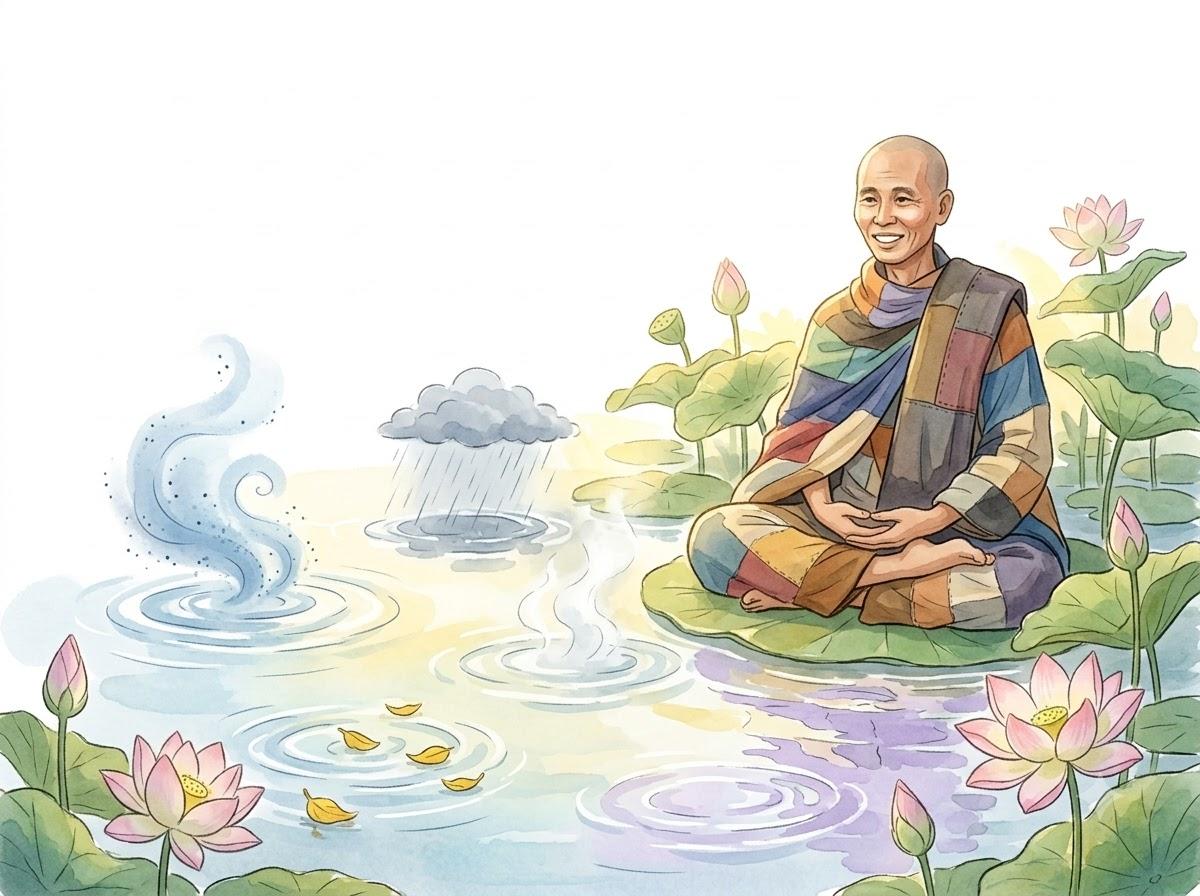
In the Sāmaññaphala Sutta (DN 2) and the Saṃyutta Nikāya (SN 46), the Buddha used five images to show what each hindrance does to the mind — through the picture of a bowl of water:
Sensual desire is like water dyed with many colors — one cannot see the bottom.
Ill-will is like water brought to a boil — always agitated, unable to reflect.
Sloth and torpor is like water covered in moss and algae — nothing inside can be seen.
Restlessness is like water blown by the wind — waves rippling, images broken.
Doubt is like water left in the dark, stirred with mud — one cannot tell light from dark, right from wrong.
Only when the water is still, clear, and calm can it mirror your face. So too, only when the mind is free of the five hindrances can it see reality as it is.
Kāmacchanda — Sensual Desire
Not merely sexual desire. Kāma includes all five sense pleasures: beautiful sights, pleasant sounds, fragrant smells, delicious tastes, agreeable touches — and, in our era, add: interesting information, notifications on a phone.
How does it show up in meditation? You sit down, and suddenly recall a favorite meal. You think of the film you plan to watch tonight. You feel a pull to check your messages.
Antidotes:
— Contemplation of the unattractive (asubha) as a counter to sensual craving for form.
— Contemplation of impermanence (anicca) toward every sense object.
— Sense restraint (indriya-saṃvara) — protecting the eyes, ears, nose from unnecessary stimulation.
— Moderation in eating.
— Association with wise friends (kalyāṇa-mitta).
Byāpāda — Ill-Will
Ill-will covers anger, resentment, irritation, annoyance — from the coarse to the most subtle.
In meditation, it appears as: replaying the memory of someone who upset you. Frustration with your posture. Dislike of the noise outside. Irritation at yourself for a restless mind.
Antidotes:
— Cultivating loving-kindness (mettā) — starting with yourself, then extending outward.
— Contemplating the eleven benefits of mettā the Buddha listed.
— Contemplating kamma: harming others harms oneself.
— Reflecting on the other person’s situation — they too may be suffering.
Thīna-middha — Sloth and Torpor
Thīna: mental sluggishness, lethargy. Middha: bodily heaviness, drowsiness.
This is perhaps the most common obstacle for beginners — every time the eyes close, they start to nod off. Or the mind grows foggy, not sharp — a feeling of “meditating” while actually drifting.
Antidotes:
— Eat less (do not meditate right after a heavy meal).
— Stand up and switch to walking meditation.
— Splash cold water on the face.
— Sit in a bright, well-ventilated place.
— Contemplate a mental image of light.
— Ensure adequate sleep at night — do not try to force alertness with caffeine.
Uddhacca-kukkucca — Restlessness and Remorse
Uddhacca: agitation, mental unrest. Kukkucca: remorse — the sting of what one did or failed to do.
The opposite of sloth and torpor. Here the mind is too active — leaping from object to object without pause. Accompanied by rumination about the past: “Why did I say that yesterday?” “If only I had done otherwise…”
Antidotes:
— Return to the breath — use it as an anchor.
— Study and firmly hold the precepts (sīla) — a mind with nothing to regret does not stir.
— Study the Dhamma, ask a teacher — confidence dissolves restlessness.
— Associate with people of stable minds — restlessness is contagious.
Vicikicchā — Doubt
Not healthy questioning (that is investigation of phenomena, dhamma-vicaya). This is doubt that paralyzes action: doubt about whether the Buddha was real, whether the Dhamma is true, whether the Sangha is worthy, whether one is capable of practice, whether the method actually works.
When doubt is strong, the practitioner quits partway. This is the most dangerous obstacle in the long run.
Antidotes:
— Study the Dhamma thoroughly — most doubt comes from lack of understanding.
— Read the Dhammapada and Nikāya suttas — hear the Buddha’s words directly.
— Small experiments: see the effects in your own experience, not by faith alone.
— Ask a teacher of realized practice.
— Remember the Kālāma Sutta: the Buddha did not say “just believe” — he said “try it and verify”.
The Five Hindrances and Master Minh Tuệ’s Way of Life
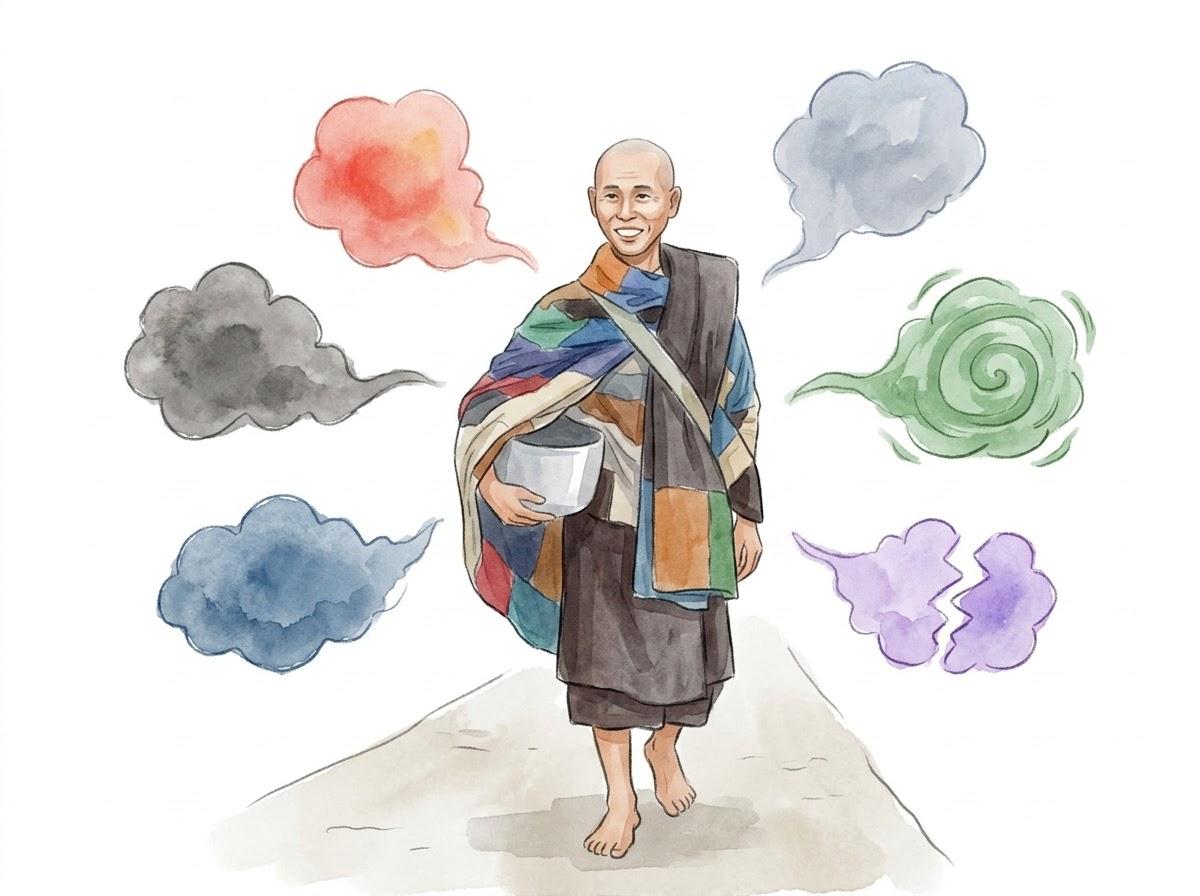
Looking at Master Minh Tuệ’s life, one can see certain features that naturally reduce the conditions for the five hindrances to arise. Not as theoretical antidotes — but as a lived environment where the hindrances find less fuel.
Countering sensual desire: One meal a day, a rag robe, no possessions, no phone. Almost all of the ordinary conditions for sensual craving are cut off. With no stimulation, desire has little on which to arise.
Countering ill-will: Silence in the face of insult. No argument. Equal treatment of those who praise and those who criticize. These are outward marks — suggesting a mind that does not feed reactions of ill-will.
Countering sloth and torpor: Walking the entire day. Eating lightly. No stimulants. The conditions for lethargy are simply absent — the body is in motion, the food is minimal, the setting is open air.
Countering restlessness and remorse: Strict adherence to the thirteen ascetic (dhutaṅga) practices. Pure precepts — nothing to regret. A simple life — few decisions, few things for the mind to stir over.
Countering doubt: Eight years of unwavering commitment to a single path. No change of method, no change of direction. This can only be sustained by a mind not shaken by doubt.
Note: This analysis is based on observable behavior, not Master Minh Tuệ’s own words about his inner experience.
Meditation Does Not Cut the Hindrances Permanently
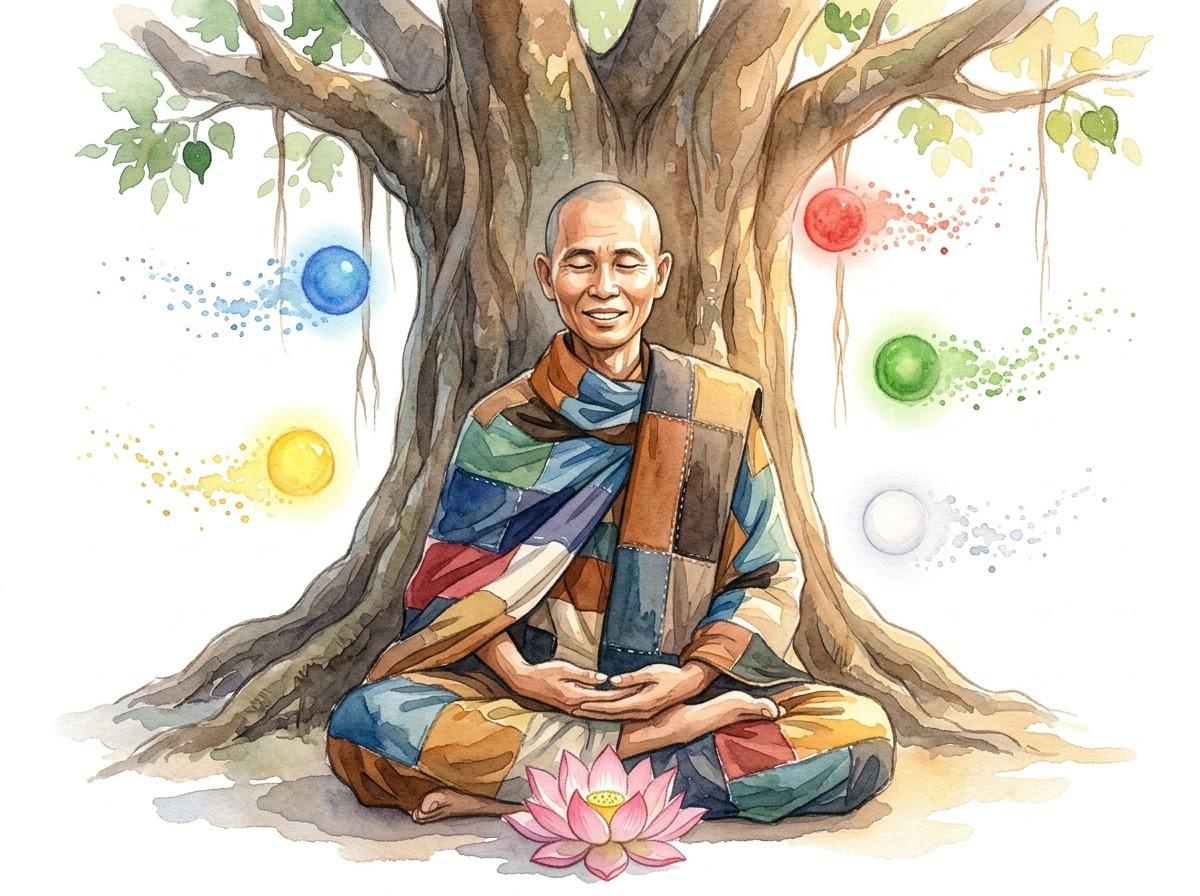
An important point: when the mind enters concentration (jhāna), the five hindrances are temporarily suppressed — not eradicated. Coming out of meditation, they can return.
Only the Four Noble Fruits uproot them permanently, in stages:
— Stream-Enterer: cuts doubt (vicikicchā).
— Non-Returner: cuts sensual desire and ill-will (kāmacchanda, byāpāda).
— Arahant: cuts all five completely.
So countering the five hindrances is daily, lifelong work — until the higher fruits are attained.
Hindrances and Fetters — What’s the Difference?
Many confuse the two.
Hindrances (nīvaraṇa) — five obstacles that manifest as a present state of mind. They can be temporarily absent (in concentration).
Fetters (saṃyojana) — ten bonds existing as latent tendencies (anusaya). Only cut by the noble fruits.
One might say: the fetters are the root, the hindrances are the manifestation when conditions arise.
Recognizing the Five Hindrances in Daily Life
Recognition is not only for sitting meditation. Throughout the day, the five hindrances take turns:
— Endlessly scrolling social media → sensual desire.
— Snapping at a family member by text → ill-will.
— The afternoon slump when you cannot focus on work → sloth and torpor.
— Lying awake, the mind racing → restlessness.
— Stalled in a project, unable to decide whether to continue → doubt.
Simply naming it correctly — “ah, this is sensual desire”, “this is ill-will” — already dissolves half of the hindrance’s power.
See also the three poisons of greed, hatred, and delusion — the deeper roots of all five hindrances.
Frequently Asked Questions
How are the hindrances different from the fetters?
Hindrances are five obstacles arising in the present mind — they can be temporarily absent. Fetters are ten deep bonds, cut only at the noble fruits. Hindrances are the surface expression; fetters are the root.
Can they be permanently overcome?
Not until one attains the noble fruits. Ordinary practitioners can only suppress them temporarily through concentration, or reduce their conditions through virtue and mindfulness. Permanent uprooting requires the insight of the Four Noble Fruits.
If I can only work on one hindrance, which should I pick?
The one strongest in you. There is no universal answer. If sensual desire dominates, practice contemplation of the unattractive and contentment (santuṭṭhi). If ill-will dominates, practice mettā. If drowsiness dominates, practice walking meditation. If restlessness dominates, practice mindfulness of breathing. If doubt dominates, study the Dhamma thoroughly.
Do the hindrances return after entering concentration?
Yes, upon leaving concentration. Concentration only suppresses them; it does not sever them. This is why teachers say: concentration must be paired with wisdom. Wisdom cuts the root; concentration enables wisdom to arise.
Where should a beginner start?
Start with recognition — just noticing “this is which hindrance” as it arises. Do not rush to counteract. After a few months of steady recognition, the antidotes become much easier to apply. What is not seen cannot be treated.