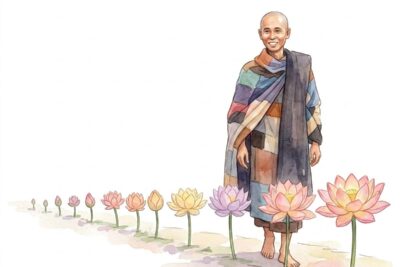
In Theravada Buddhism, the path of practice is not a vague current that drifts along “wherever it leads”.
The Buddha marked out four clear milestones — four fruits (phala) that a practitioner may realize on the road to complete liberation.
These are the Four Noble Fruits: Stream-Enterer (Sotāpanna), Once-Returner (Sakadāgāmi), Non-Returner (Anāgāmi), and Arahant.
Four stages — each removing certain fetters (saṃyojana, the bonds that tie the mind to saṃsāra) — until all ten are cut.
This article explains the four fruits, and addresses a sensitive question many people ask: “Which fruit has Master Minh Tuệ attained?”
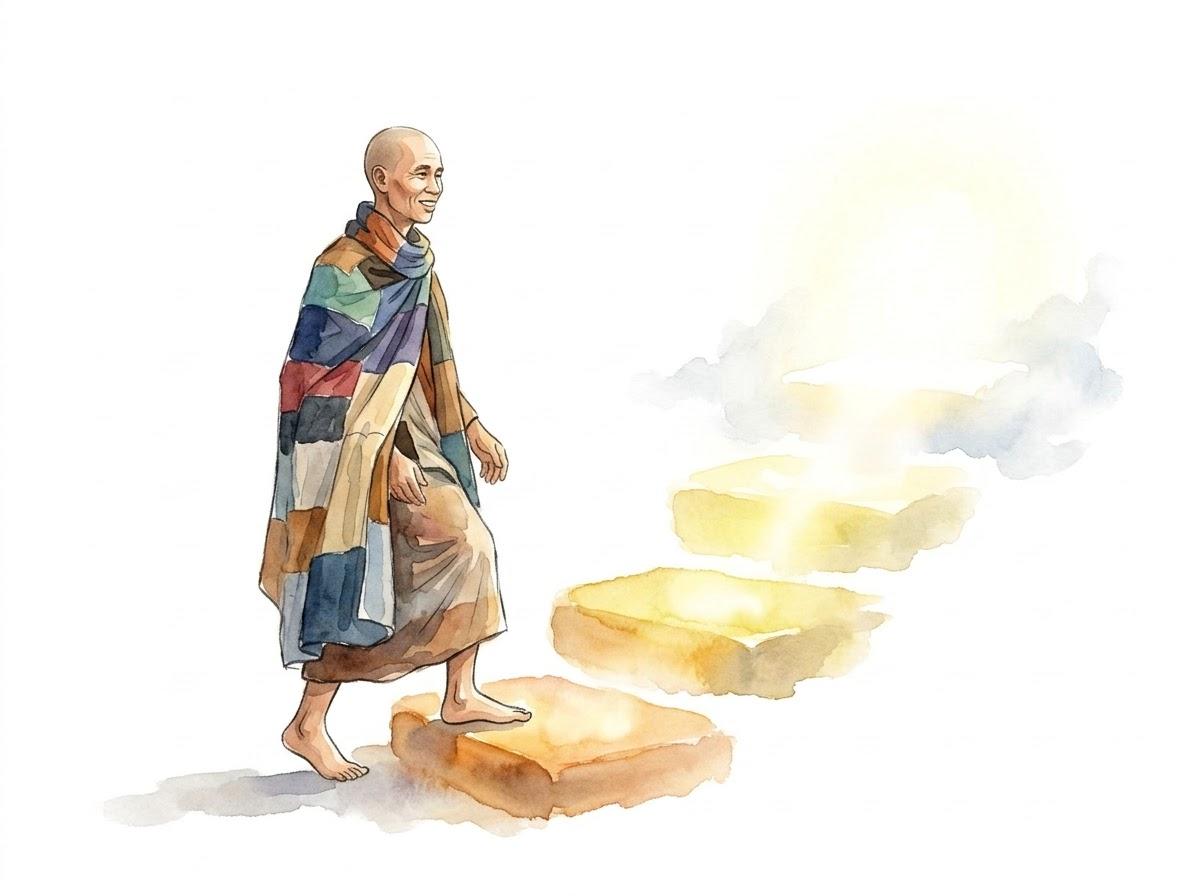
What Are the Four Noble Fruits?
The Four Noble Fruits (ariya-puggala) are the four types of noble ones — those who have entered the stream of liberation and can no longer fall back off the path.
Each fruit has two aspects: the path (magga — the moment of mind that cuts the fetter) and the fruit (phala — the resulting state of mind after the cut).
The four fruits:
1. Sotāpanna — Stream-Enterer.
2. Sakadāgāmi — Once-Returner.
3. Anāgāmi — Non-Returner.
4. Arahant — the Worthy One, one no longer subject to rebirth.
What each fruit cuts is a set of fetters (saṃyojana) — the ten bonds that keep beings turning in the wheel of birth and death.
Sotāpanna — Stream-Enterer
Sota means “stream”. Sotāpanna: one who has entered the stream — the current flowing toward Nibbana.
The Stream-Enterer eliminates the first three fetters:
1. Personality view (sakkāya-diṭṭhi) — the illusion of a permanent “self” within the five aggregates.
2. Doubt (vicikicchā) — doubt about the Buddha, Dhamma, Sangha, and the path.
3. Clinging to rites and rituals (sīlabbata-parāmāsa) — attachment to mistaken observances.
Characteristic: the Stream-Enterer can no longer be reborn in the lower realms (hell, hungry ghosts, animals, asuras). At most, seven more lives in the human or heavenly realms remain — after which liberation is certain.
Sakadāgāmi — Once-Returner
Sakadāgāmi: one who “returns only once” to this world.
The Once-Returner does not cut new fetters, but weakens the next two:
4. Sensual craving (kāmarāga) — desire for the pleasures of the five senses.
5. Ill-will (paṭigha) — aversion, dislike, resentment.
Craving and aversion in the Once-Returner’s mind are no longer coarse — only subtle traces remain. Only one more birth in the sense-sphere remains before liberation.
Anāgāmi — Non-Returner
Anāgāmi: one who “does not return” to the sense-sphere.
The Non-Returner completely uproots the fourth and fifth fetters — even the subtle traces of sensual craving and ill-will are gone.
After the body’s death, the Non-Returner is reborn in the Pure Abodes (Suddhāvāsa, five special form-realm heavens) and attains Arahantship there — never returning to the sense-sphere.
At this level, five higher fetters remain:
6. Craving for form-realm existence (rūparāga).
7. Craving for formless-realm existence (arūparāga).
8. Conceit (māna) — the subtle sense of “I am”.
9. Restlessness (uddhacca) — subtle stirring of the mind.
10. Ignorance (avijjā) — not seeing things as they really are.
Arahant — the Worthy One
Arahant: the one worthy of offerings — also translated as “one who no longer takes birth”.
The Arahant has severed all ten fetters. Every craving, aversion, and delusion — coarse or subtle — has been extinguished.
After the body’s death, the Arahant enters Nibbana without residue (anupādisesa-nibbāna) — never again reborn in any realm. The round of saṃsāra ends.
This is the final goal of the path in Theravada Buddhism — Nibbana, the complete extinguishing of greed, hatred, and delusion.
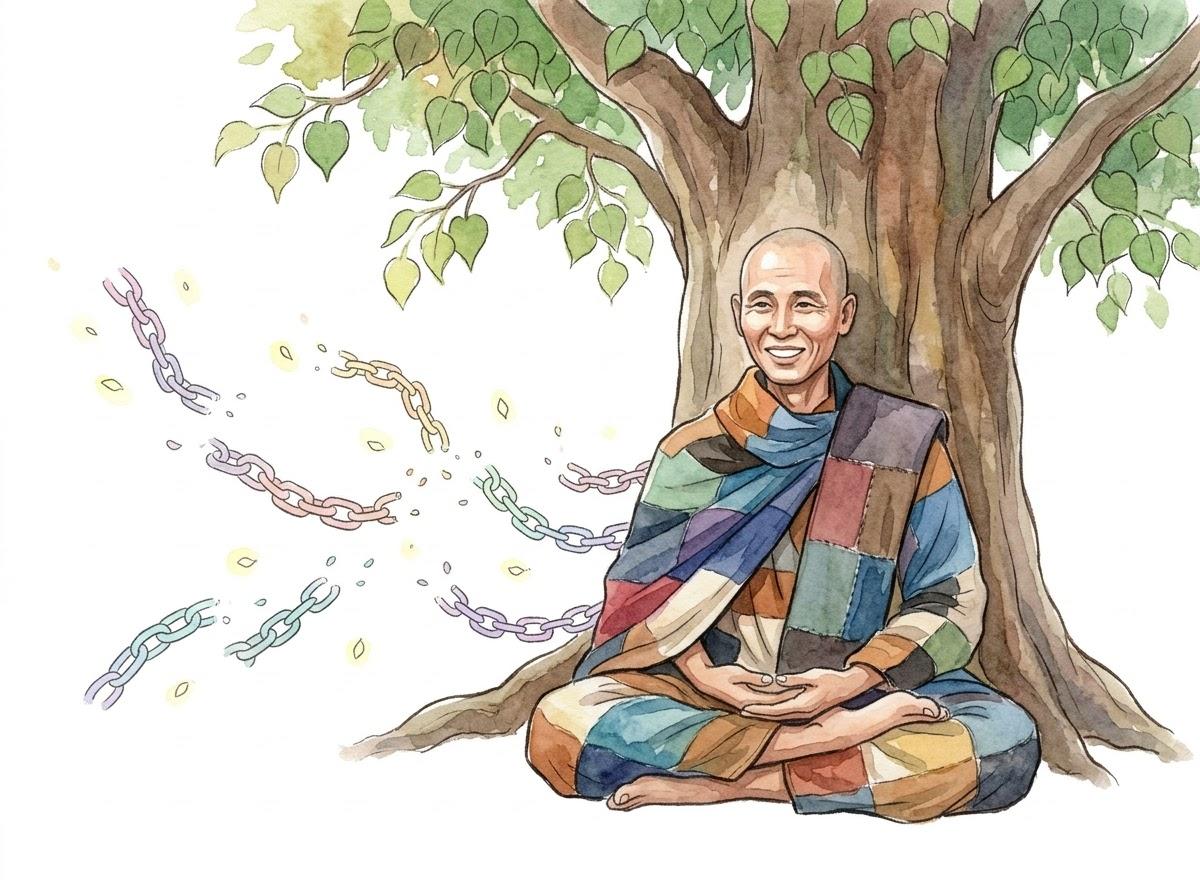
The Ten Fetters Cut at Each Fruit
A summary:
Stream-Enterer: cuts the first three fetters (personality view, doubt, clinging to rites).
Once-Returner: weakens fetters 4 and 5 (sensual craving, ill-will).
Non-Returner: completely uproots fetters 4 and 5.
Arahant: cuts fetters 6 through 10 (form craving, formless craving, conceit, restlessness, ignorance).
Four fruits + the four paths leading to each = eight types of noble persons (aṭṭha-ariya-puggalā). These eight form the noble Sangha — the object of refuge when we say “I go for refuge to the Sangha”.
In the Sekha Sutta (AN 3.85), the Buddha calls the first three — Stream-Enterer, Once-Returner, and Non-Returner — sekha (“trainees still in training”), because they still have fetters to cut and a path still to walk. Only the Arahant is asekha (“beyond training”, one whose work is done). This sutta is the canonical source for the three stages of noble trainees before Arahantship, and it shows that the Four Noble Fruits form a single continuous process — not four disconnected states.
The Ten Fetters in More Detail
Because the whole scheme of the four fruits turns on the cutting of fetters, a closer look at the ten helps.
The first five are called the lower fetters (orambhāgiya-saṃyojana) — they bind beings to the sense-sphere. The last five are the higher fetters (uddhambhāgiya-saṃyojana) — they bind beings to the form and formless realms.
Personality view is not merely an intellectual belief in a soul — it is the felt sense that “this body-and-mind is me, is mine, is my self.” The Stream-Enterer sees through it experientially, not just conceptually. Doubt is not scholarly skepticism but the uncertainty that prevents one from settling into practice. Clinging to rites is trusting that outward observances alone can purify — bowing, chanting, or vows separated from wisdom and virtue.
The middle two — sensual craving and ill-will — are the fetters most ordinary practitioners struggle with daily. They are only truly uprooted at the Non-Returner stage; before that, mindfulness merely holds them at bay.
The final five are subtle in the extreme. Māna — the residue of “I am” — persists even when personality view has been dropped: a whisper of self-comparison, of noticing oneself as noticer. Only the Arahant is free of it.
On the Question “Which Fruit Has Master Minh Tuệ Attained?”
Many people are curious about this. The most honest answer is: no outside observer has the authority to judge.
The Buddha was very strict about claims of attainment. In the Vinaya, falsely declaring one’s own attainment is one of the four Pārājika offenses — the gravest, resulting in loss of the monastic status. Judging the attainment of others is likewise an extremely sensitive matter.
Only two persons can know with certainty:
— The practitioner himself, through direct realization.
— A being of equal or higher attainment — one with sufficient knowledge of others’ minds (ceto-pariya-ñāṇa) to perceive another’s inner state.
The writer of this article is neither. Nor is any ordinary reader.
What can be observed is outward behavior: Master Minh Tuệ upholds the thirteen ascetic (dhutaṅga) practices, does not receive money, remains silent under insult, treats praise and criticism equally. These are marks of a serious practitioner.
But outward marks are not enough to conclude anything about inner attainment. Some with very pure minds may appear ordinary; some with a saintly appearance may not yet have uprooted anything at all.
The most respectful answer is the humble one: we do not know, and we do not need to know. What is worth learning from Master Minh Tuệ lies in his conduct and his spirit of practice — not in slotting him into a stage.
Note: This analysis is based on observable behavior, not Master Minh Tuệ’s own words about his inner experience. When asked about attainment, Master Minh Tuệ himself typically replies that he is only practicing, and would not presume to claim anything.

Why the Buddha Often Refused to Answer Questions About Attainment
In the Aggi-Vacchagotta Sutta (MN 72), when the wanderer Vaccha asked about the nature of an Arahant after death — the Buddha remained silent, or answered with the image of a fire gone out: one cannot say the flame went east, west, north, or south.
The reason: the attainments and states of the noble ones exceed the reach of dualistic language. The more one tries to describe them, the more easily they are misunderstood.
What the Buddha encouraged was not discussion of attainment — but walking the path that leads to it. That path consists of the Noble Eightfold Path and the contemplation of Dependent Origination.
The Four Fruits in Mahāyāna Buddhism
Note: this system of Four Noble Fruits belongs to Theravada Buddhism.
Mahāyāna Buddhism has its own framework — the Ten Bhūmis of the Bodhisattva — ten stages of the Bodhisattva path leading to Buddhahood. The two systems are not contradictory but have different emphases: Theravada highlights personal liberation through the four fruits; Mahāyāna highlights the Bodhisattva path of liberating all beings.
Frequently Asked Questions
Can laypeople attain Stream-Entry?
Yes. The suttas record many laypeople attaining Stream-Entry without ordaining. The conditions: hearing the right teaching, right faith (saddhā), serious practice, and having favorable karmic connections with the Dhamma.
Do those who attain the fruits still take rebirth?
Stream-Enterer: at most seven more lives. Once-Returner: one more life in the sense-sphere. Non-Returner: never again in the sense-sphere but still reborn in the form realm. Arahant: no further rebirth — the round ends.
How do I know whether I have attained a fruit?
There is no way to be “100 percent certain” apart from direct inner realization. Reference signs: no doubt about the Triple Gem, no illusion of a permanent self, no clinging to blind rituals. But even these can be confused with mere intellectual understanding. The Buddha’s advice: do not try to place yourself in any stage — just keep practicing.
Why is it forbidden to declare one’s own attainment?
Because a false declaration (whether deliberate or careless) is a grave offense, causing loss of monastic standing. Even a true declaration, if unnecessary, was rebuked by the Buddha — as it easily breeds pride and disturbs others.
Must the four fruits be attained strictly in order?
Yes. The four fruits are four sequential stages — no skipping. But the time between them varies widely: some attain all four in a single mind-moment (extremely rare); others take many lifetimes to complete the path.