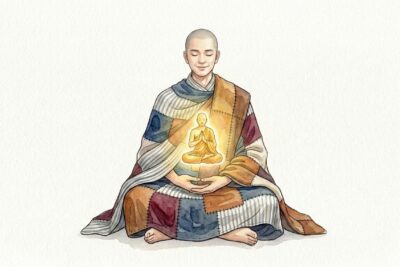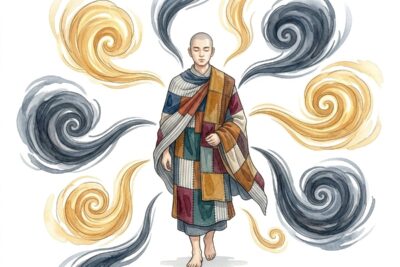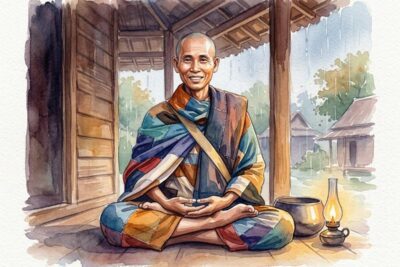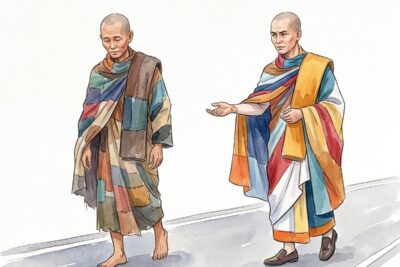
In everyday life, the mind works chiefly by cutting things in half.
Gain — loss. Praise — blame. Beautiful — ugly. Self — other. Birth — death. Every time it meets something, the mind takes a side, clings to the one it likes, and pushes away the one it does not.
Buddhism points to a different way of seeing — one that goes beyond these paired opposites, not by fusing them into one and not by denying that they differ, but by seeing through the very mechanism of dividing.
The Mahāyāna tradition calls this non-duality (Sanskrit: advaya). The Theravāda tradition does not use this term, but carries a spirit that runs very close: the Middle Way that transcends paired extremes. This article presents both approaches, without favoring either, to show how two great streams of Buddhism point at the same deep way of seeing.
What Is Non-Duality?
The Sanskrit word advaya is built from a- (“not”) and dvaya (“two”). A literal rendering: “not-two”. Chinese translators rendered it as bù èr (不二), reaching Vietnamese Buddhism through Northern schools as bất nhị.
The first point to clarify: not-two does not mean one. If non-duality simply meant “one”, it would collapse into a form of monism — merely the opposite pole of dualism. Buddhism does not teach this.
Non-duality is a way of seeing in which the mind no longer cuts reality into two opposing halves. Birth and death still occur — but the one who sees no longer grasps one side and pushes the other away. Good and evil still appear — but the one who sees no longer clings to those labels as if they named solid things.
Put another way: non-duality does not deny distinctions at the conventional level. It transcends clinging to those distinctions at the ultimate level.
The Origin: The Vimalakīrti Sūtra and the Chapter on Entering the Gate of Non-Duality
The classic scripture on non-duality is the Vimalakīrti Sūtra (Sanskrit: Vimalakīrti Nirdeśa Sūtra), a Mahāyāna text appearing in India around the first to second century CE, later translated into Chinese through several versions (Kumārajīva’s being the most widely read).
Its central figure is Vimalakīrti, a lay householder whose wisdom equals — and sometimes surpasses — that of the great bodhisattvas and senior disciples of the Buddha. The Mahāyāna text is affirming that awakened wisdom is not confined to the ordained sangha.
In the Chapter on Entering the Gate of Non-Duality (Chapter 9), Vimalakīrti asks a question: “How does a bodhisattva enter the gate of non-duality?”
Thirty-one bodhisattvas answer in turn, each naming a pair of opposites and showing the way through: arising and ceasing (phenomena are unborn from the start, so nothing ceases); self and what belongs to self (without a self, nothing belongs to it); defilement and purity (defilement itself is empty of intrinsic nature, so purity is not set against it). Thirty-one answers unfold in this way.
Finally, the bodhisattva Mañjuśrī answers: “In my view, with regard to all phenomena, no speaking, no explaining, no pointing, no knowing, apart from all question and answer — this is entering the gate of non-duality.”
Then Mañjuśrī turns the question back on Vimalakīrti. The sutra records: Vimalakīrti remained silent, and did not speak a single word. Mañjuśrī then praises him: “Excellent! Even to be without letters and words — this is truly entering the gate of non-duality.”
Later Chan masters called this “the silence that thunders”. At the ultimate reach, even the words “not-two” still divide the object in order to describe it. Only a wakeful silence escapes the trap of dualistic language.
Common Dualistic Pairs Transcended in Mahāyāna
The Mahāyāna tradition names many pairs to which the ordinary mind clings. Seeing through them is the practice of a lifetime.
Birth — death. “Birth” is only the coming-together of conditions; “death” only their coming-apart. No independent thing truly arises or truly perishes.
Good — evil. Buddhism keeps the distinction intact on the path — keep the precepts, do what is wholesome, avoid what is harmful. But at the ultimate view, the practitioner does not cling to “I am a good person” or “that one is an evil person” as if these were solid entities.
Ordinary — noble. The distinction between the ordinary being and the awakened one points out the path. Clinging tightly to that boundary is itself confusion. The nature of awakening is not added to the noble and not subtracted from the ordinary.
Saṃsāra — Nirvāṇa. The beginner imagines Nirvāṇa as another realm, reached by leaving saṃsāra behind. Nāgārjuna, in his Fundamental Verses on the Middle Way (Chapter 25), teaches in essence: not the slightest difference separates the two. Not two places — only whether the mind clings or not.
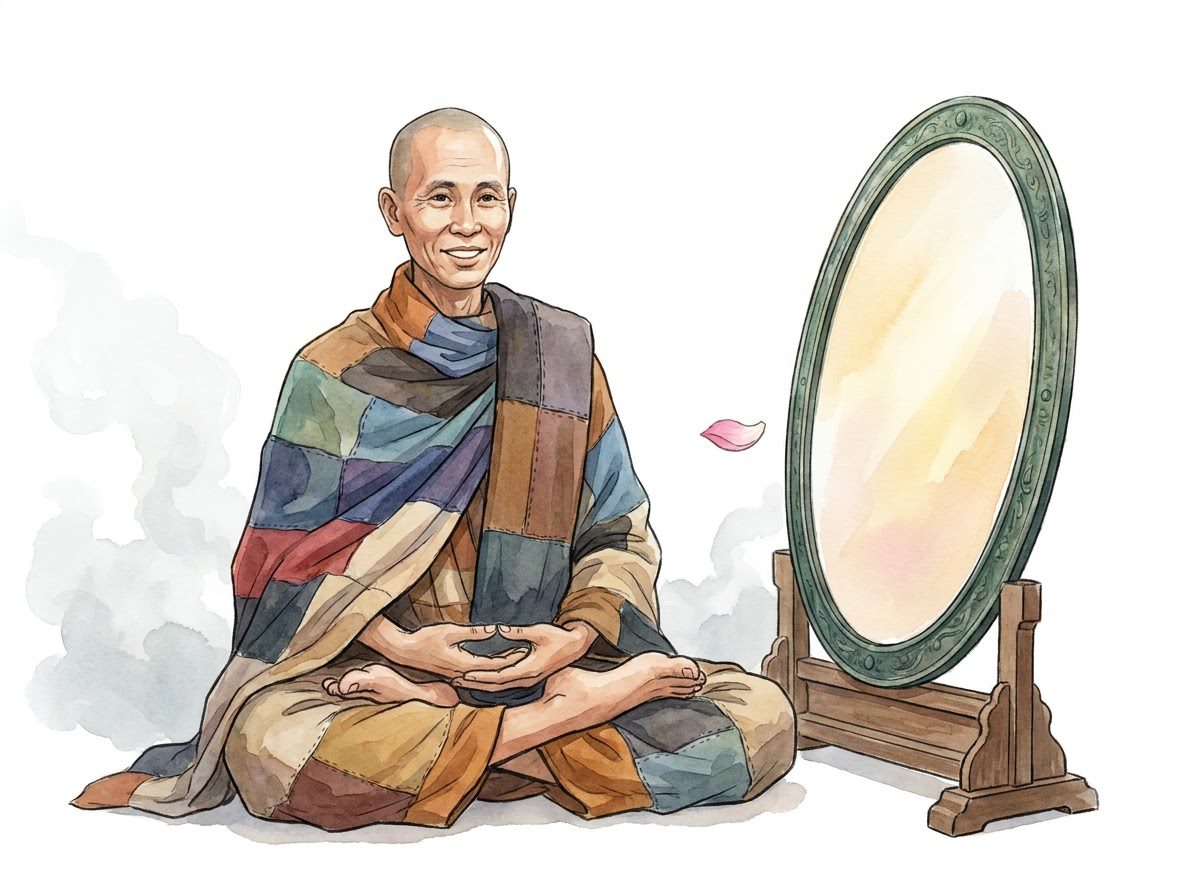
Defilement — purity. Dust on a mirror does not turn the mirror into something else — wipe the dust away, the mirror remains the mirror. What is polished and what needed no polishing are, at the level of nature, not two.
Existence — non-existence. Ordinary minds cling to one pole or the other. Non-duality points out that both extremes are limited views — both must be released together.
Non-Duality in Mahāyāna: Madhyamaka, Prajñāpāramitā, and Chan
Three great Mahāyāna currents approach non-duality in slightly different ways, but converge on the same point.
Madhyamaka. The Fundamental Verses on the Middle Way (Sanskrit: Mūlamadhyamakakārikā) of Nāgārjuna (approximately second century CE) employs the tetralemma: a phenomenon is not “is”, not “is-not”, not both, and not neither. All four extremes are refuted — not to fall into nihilism, but so the mind finds no solid concept to cling to.
Prajñāpāramitā. The Perfection of Wisdom literature — with the Diamond Sūtra and the Heart Sūtra as its widely read short forms — emphasizes the emptiness (Sanskrit: śūnyatā) of all phenomena. The famous line from the Heart Sūtra, “form is not different from emptiness, emptiness is not different from form”, is a direct expression of the non-dual spirit.
Chan (Zen). Chan turned non-duality into direct practice. Kōans set up situations the dualistic mind cannot solve — forcing the meditator to release the very habit of splitting. A classic example is Huineng, the Sixth Patriarch, watching two monks argue about a flag moving in the wind: “It is not the wind that moves, not the flag that moves — it is your mind that moves.”
An Equivalent Spirit in Theravāda: The Middle Way and Dependent Origination
A point to make plainly: Theravāda Buddhism does not use the term “non-duality”. That is a Mahāyāna keyword. Yet the spirit of transcending paired extremes is clearly present in the Nikāya collections, under a different name: the Middle Way (Pāli: majjhimā paṭipadā).
In his very first discourse at the Deer Park, the Buddha taught the Middle Way as the path avoiding two extremes: self-mortification and self-indulgence. Walking the middle — not in a mechanical sense, but in the deeper sense of going beyond the mechanism of opposites.
The most direct discourse on the spirit of transcending pairs is the Kaccānagotta Sutta — Saṃyutta Nikāya 12.15. There, the venerable Kaccāna asks about right view. The Buddha teaches, in essence: the world for the most part depends upon two extremes — “existence” (Pāli: atthi) and “non-existence” (Pāli: natthi). One who sees rightly the arising of the world with right wisdom no longer leans to “non-existence”. One who sees rightly its cessation no longer leans to “existence”.
The Buddha then introduces the Middle Way: avoiding both extremes through dependent origination (Pāli: paṭiccasamuppāda) — with the arising of this, that arises; with the ceasing of this, that ceases.
Nāgārjuna’s Madhyamaka school later cited this very sutta as one of its scriptural foundations. The Middle Way of Theravāda and the Non-Duality of Mahāyāna point at the same way of seeing, differing in terminology and unfolding. Likewise, dependent origination transcends other great pairs: eternalism and annihilationism, identity and difference — the same spirit of going beyond pairs, expressed in Nikāya language.
Readers interested in the shared foundation of both traditions may explore dependent origination and the Middle Way.
What Non-Duality Is NOT
This is the section most easily misread. Clarifying it helps guard against leaning off-course.
Not the Advaita Vedanta of Hinduism. Advaita Vedanta — the system articulated by Śaṅkara (approximately eighth century CE) — teaches that Ātman (individual self) and Brahman (the universal Absolute) are one: ultimately, only one reality exists. Buddhist non-duality, by contrast, does not affirm any single ultimate substance — such an affirmation would itself be a form of clinging to “existence”. The two traditions share the Sanskrit root, but their content differs. This distinction is made with respect: Advaita Vedanta is a profound tradition on its own terms.
Not “everything melts into one”. A stone remains a stone, rain remains rain, a person of good conduct remains a person of good conduct. Non-duality does not erase distinctions at the relative level. It only ends clinging to those distinctions as if they were the final nature of things.
Not the denial of ethics. Some misuse “non-duality” to justify breaking the precepts: “good and evil are not-two, so keeping the precepts makes no difference”. This is a serious misreading. In the relative life, the practitioner keeps the precepts fully. Non-duality is the inner view within which practice unfolds, not an excuse to abandon outward discipline.
Not moral relativism. “Everything is the same, there is no right and wrong” — that is relativism, not non-duality. Non-duality leaves fully intact the truth about suffering and the path leading out of suffering. The Four Noble Truths are not dissolved by non-dual insight.
Not a state one reaches and remains in. It is a way of seeing that arises through the sustained cultivation of virtue, concentration, and wisdom — not a realm one steps into and inhabits forever.
Applying the Spirit of Non-Discrimination in Daily Life
Non-duality sounds abstract, but its application is very concrete.
Seeing right and wrong without clinging to right and wrong. One still recognizes what is harmful and what is beneficial. But one does not grip “I am always right, the other is wrong” so tightly that the mind hardens. Discernment remains; clinging drops.
Seeing praise and blame without agitation. Praise arrives — known as praise. Blame arrives — known as blame. One does not swell when praised, does not shrink when blamed. Both are only conditions arising and passing.
Seeing gain and loss without being carried off. The pleasant feeling of gain and the painful feeling of loss are not denied — but one does not identify with them. Feelings come and go. The one who knows the feelings remains, unswept.
Seeing beautiful and ugly without being bound by form. Beauty is recognized, coarseness is recognized. But the mind does not fasten onto them to the point of greed or aversion.
None of these applications requires the term “non-duality” — only steady contemplative practice. Theravāda calls this right mindfulness and right view. Mahāyāna calls this the contemplation of non-duality. The names differ; the doing is very close.

Master Minh Tuệ and the Spirit of Non-Discrimination
A clarification first: Master Minh Tuệ practices within the Theravāda tradition, drawing on the Nikāya collections. In various public videos, he has spoken in essence about the precepts, the dhutaṅga austerities, the Four Noble Truths, and the Noble Eightfold Path. He does not teach “non-duality” in the Mahāyāna sense — this must be said plainly, so no words are placed in his mouth that he has not spoken.
And yet his way of life — observed from outside — is a living expression of the spirit of transcending opposites.
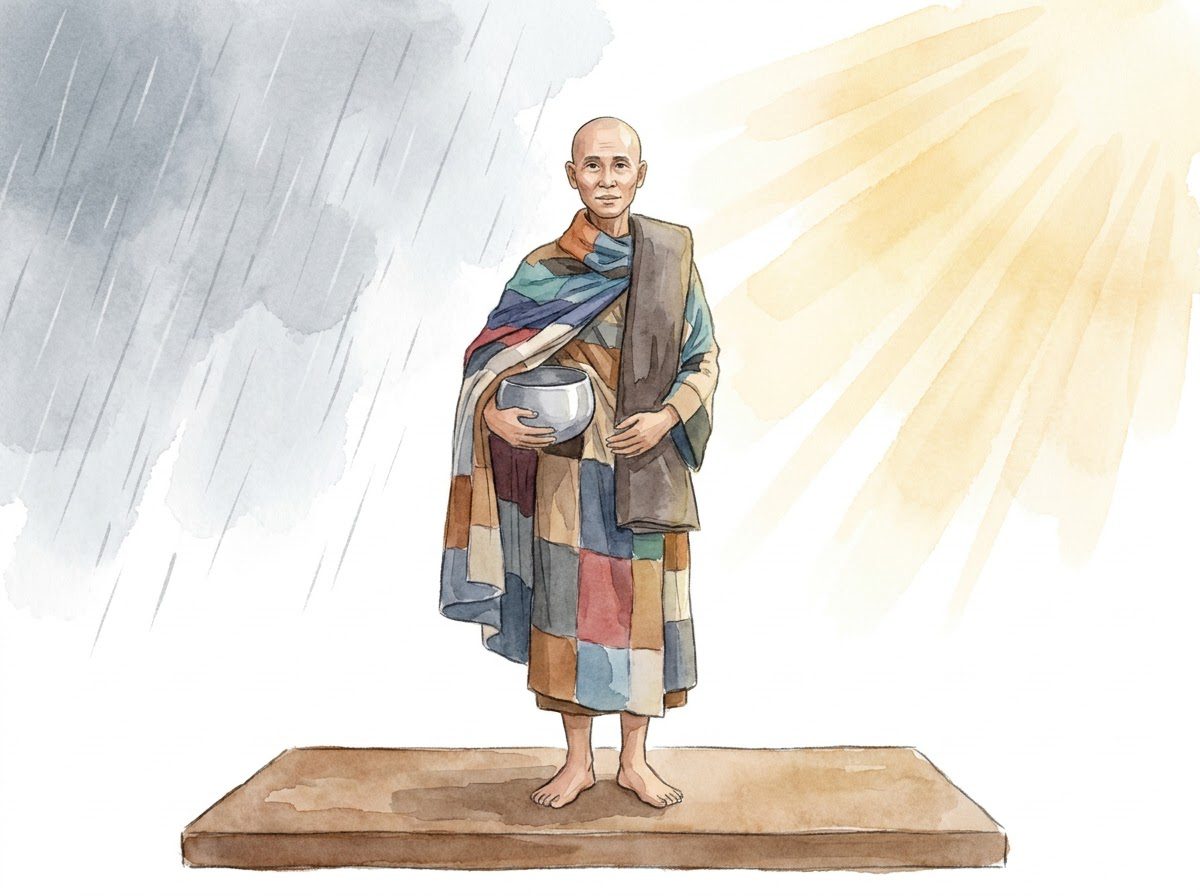
He walks for alms. Food received is known as received; food not received is known as not received. He does not treat the giver as dear and the non-giver as unwelcome. Whether the house is wealthy or poor, the street crowded or quiet, his step keeps the same rhythm.
The food he receives. Tasty or plain, enough or little, all of it only sustains the body for another day of walking — a traditional dhutaṅga practice, and equally a living expression of non-discrimination in eating.
Concerning possessions, he keeps the practice of not handling money and not accepting gold or silver — not because money is bad, but because for him, coins and pebbles on the road carry no distinction worth clinging to.
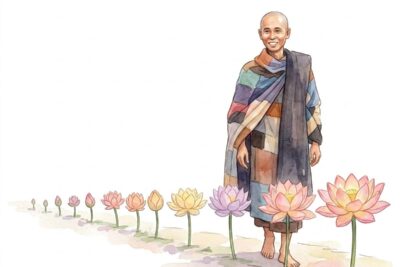
Regarding praise and blame, public footage shows him passing through crowds offering veneration without stopping to receive the honor, and passing through waves of criticism without turning back to defend himself. A path strewn with flowers and a path scattered with dust are walked with the same barefoot rhythm.
Seen in Theravāda vocabulary, this is equanimity (Pāli: upekkhā) in an unshaken mind. Seen in Mahāyāna vocabulary, this is a living expression of non-duality: not gripping either pole of gain–loss, praise–blame, tasty–plain. One way of life — practitioners of either tradition can recognize the familiar spirit of their own school within it.
Note: This is analysis based on observable behavior, not the Master’s own words about his inner experience.
Frequently Asked Questions
Are Non-Duality and the Middle Way the same?
Not identical, but pointing to the same way of seeing. The Middle Way is a Theravāda term for transcending self-mortification and self-indulgence, existence and non-existence. Non-Duality is a Mahāyāna term extended to many more pairs. Nāgārjuna’s Madhyamaka is the philosophical bridge between the two.
Does “non-duality” mean abandoning moral distinctions and precepts?
Not at all. On the level of lived practice, Buddhism keeps the distinction between wholesome and unwholesome fully intact and requires the keeping of the precepts. Non-duality is the inner view that keeps the practitioner from clinging to distinctions as if absolute — never an excuse to break the precepts, a distortion classical Mahāyāna masters warned against repeatedly.
How does Buddhist advaya differ from Hindu Advaita Vedanta?
They share the Sanskrit root, but their content differs. Advaita Vedanta affirms a single ultimate reality (Brahman) with which the individual self (Ātman) is identical. Buddhist advaya affirms no single ultimate substance — such an affirmation would itself be clinging. This is a core distinction between not-self (anattā) in Buddhism and the self-doctrine of Vedanta, held with mutual respect between the traditions.
Does Theravāda have “non-duality”?
Theravāda does not use the term. But it carries an equivalent spirit through the Middle Way, dependent origination transcending eternalism and annihilationism, and the Kaccānagotta Sutta (Saṃyutta Nikāya 12.15) — equivalent content in a different vocabulary.
Does Master Minh Tuệ teach non-duality?
Based on public videos, the Master teaches in the Theravāda spirit and does not use the term “non-duality”. Attributing the Mahāyāna concept to his speech would not be accurate. Yet his way of life — observed from outside — expresses the spirit of transcending opposites very clearly, and this is something practitioners of both traditions may reflect on together.