If you had to choose a single teaching to represent the entirety of the Buddha’s message, many scholars would choose the Noble Eightfold Path.
Not because it is simple — but because it is complete. Eight factors cover every dimension of life: thought, speech, action, livelihood, effort, mindfulness, and meditation. Nothing missing, nothing superfluous.
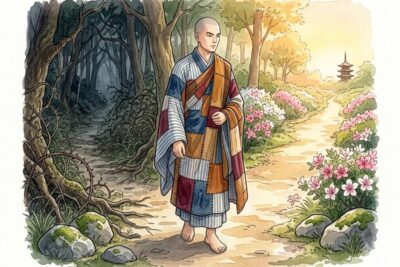
The Buddha called it the Middle Way (Majjhimā Paṭipadā) — the path between two extremes: indulgence in sensual pleasure and extreme self-mortification.

The Eight Factors of the Noble Eightfold Path
The Noble Eightfold Path (Ariyo Aṭṭhaṅgiko Maggo) was taught by the Buddha in his very first discourse at the Deer Park — the Dhammacakkappavattana Sutta (SN 56.11). The eight factors fall into three groups:
WISDOM (Paññā):
1. Right View (Sammā-diṭṭhi) — Seeing things as they truly are. Understanding the Four Noble Truths: suffering, its origin, its cessation, and the path to its cessation. Right view is the foundation — if the initial vision is wrong, everything that follows goes astray.
2. Right Intention (Sammā-saṅkappa) — Wholesome thought: intention of renunciation (non-greed), intention of goodwill (non-hatred), and intention of harmlessness (non-cruelty). This is not about thinking more or thinking cleverly — it is about directing thought toward what is wholesome.
VIRTUE (Sīla):
3. Right Speech (Sammā-vācā) — Abstaining from lying, from divisive speech, from harsh speech, and from idle chatter. These four “abstentions” sound straightforward — but try maintaining all four for a single day and you will see how challenging it is.
4. Right Action (Sammā-kammanta) — Abstaining from killing, from stealing, and from sexual misconduct. This is the ethical bedrock — without it, every other practice is built on sand.
5. Right Livelihood (Sammā-ājīva) — Earning a living in ways that do not cause harm to others or to oneself. The Buddha listed five trades to avoid: trading in weapons, in human beings, in meat, in intoxicants, and in poisons.
CONCENTRATION (Samādhi):
6. Right Effort (Sammā-vāyāma) — The Four Right Efforts: preventing the unwholesome, abandoning the unwholesome, cultivating the wholesome, maintaining the wholesome. Not blind striving, but effort with clear direction.
7. Right Mindfulness (Sammā-sati) — Moment-to-moment awareness: clearly knowing what the body is doing, what the mind is thinking, what feelings are present. Mindfulness is the glue that holds all the other factors together.
8. Right Concentration (Sammā-samādhi) — Proper unification of mind: the four levels of meditative absorption (jhāna) — from a mind still engaged with applied and sustained thought, to a mind resting in pure equanimity and mindful clarity. Right concentration is not an empty mind — it is a mind that is lucid, stable, and settled.
Eight Factors, Not Eight Steps
A common misunderstanding: thinking the Noble Eightfold Path is a sequence of eight steps to be completed in order — finish right view, then move to right intention, then right speech…
Not so. The eight factors develop simultaneously — like eight spokes of a wheel, supporting each other as they turn together. Practicing mindfulness sharpens right view. Sharper right view directs right effort more accurately. All factors reinforce one another.
Right view is listed first for a reason, however: without seeing clearly, one cannot walk correctly. Understanding the Four Noble Truths is the most natural starting point.
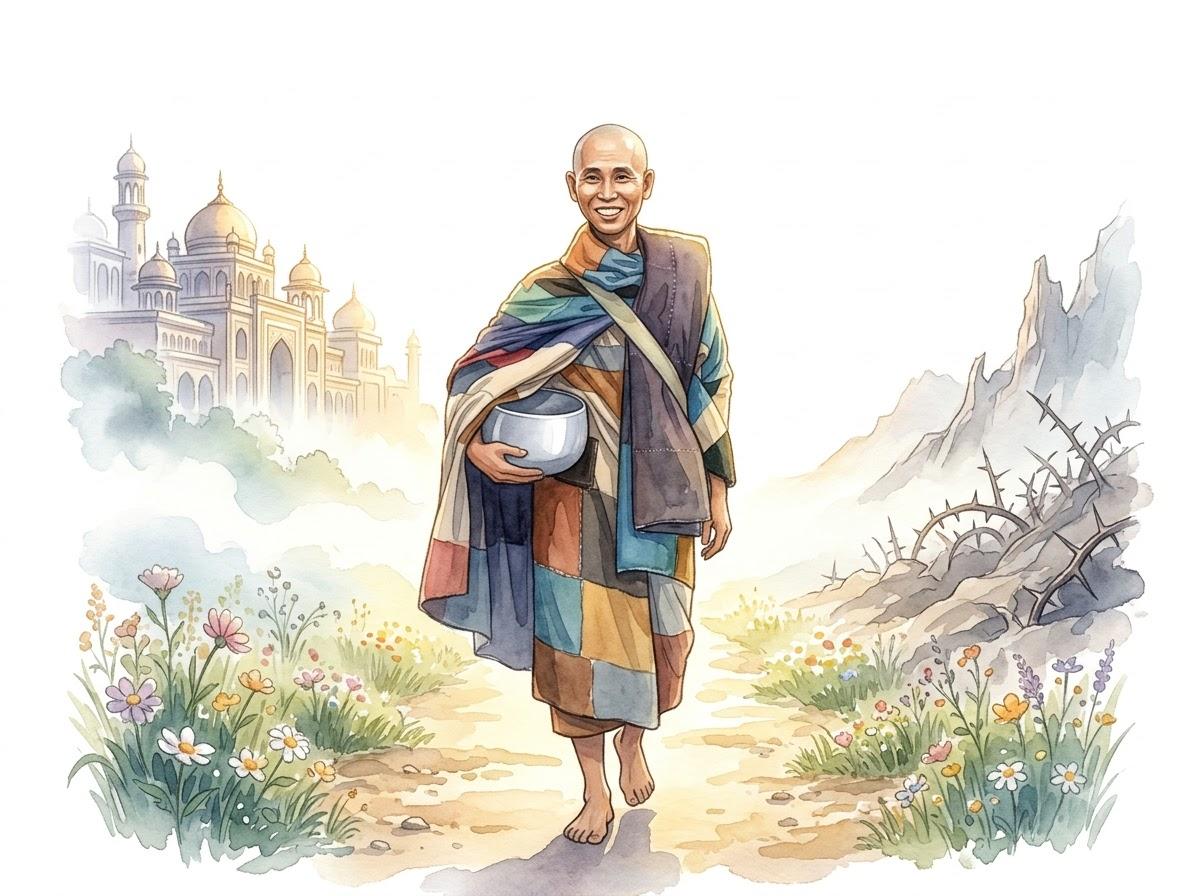
The Middle Way Is Not a Compromise
The Buddha taught the Noble Eightfold Path as the Middle Way (Majjhimā Paṭipadā) — the path between two extremes:
The first extreme: chasing sensual pleasure — believing happiness lies in satisfying every desire.
The second extreme: self-mortification — believing that tormenting the body leads to liberation.
The Middle Way is not “doing things halfway” or settling for less. It is the path of wisdom — recognizing that both indulgence and self-torture fail to produce freedom, then choosing what actually works.
The Buddha knew this from personal experience: six years of extreme austerity did not bring awakening. And before that, a life of royal luxury brought no lasting peace. The Noble Eightfold Path was born from understanding both sides.
Master Minh Tuệ and the Noble Eightfold Path in Every Step
The Buddha taught the Noble Eightfold Path in his very first discourse (Dhammacakkappavattana Sutta, SN 56.11) — and it is the path he returned to most frequently across 45 years of teaching. The eight factors are not sequential steps — they develop together, supporting one another. Looking at Master Minh Tuệ’s practice journey, one can observe all eight factors present simultaneously in a single way of life.
Right View (sammā diṭṭhi): The foundation of the entire path. Master Minh Tuệ clearly perceives that possessions, status, and comfort are not sources of genuine happiness — and so he relinquishes them all. The Buddha defined right view as understanding the Four Noble Truths: suffering, its origin, its cessation, and the path to cessation. When a person renounces all worldly things to live as a barefoot alms-walker — that is not impulsive behavior, but the expression of a vision that has been transformed at its root.
Right Intention (sammā saṅkappa): The Buddha taught three kinds of right intention: the intention of renunciation (nekkhamma), of goodwill (abyāpāda), and of harmlessness (avihiṃsā). Master Minh Tuệ does not think in terms of accumulation; he does not nurture resentment or jealousy. His mind inclines toward letting go — and that inclination is expressed through his entire way of living, not merely through words.
Right Speech (sammā vācā): Four dimensions: no lying, no divisive speech, no harsh speech, no idle talk. He speaks little and speaks gently, without argument or self-justification. Amid controversy and public debate about him, he chooses silence — not from fear, but from understanding that silence at the right moment is the highest form of right speech.
Right Action (sammā kammanta): Living without causing harm — no killing, no taking what is not given, a life of purity. For a walking practitioner, even each footstep is an act: choosing to step lightly, not treading on insects, not damaging the environment — all of this falls within the scope of right action.
Right Livelihood (sammā ājīva): This is the factor Master Minh Tuệ embodies most thoroughly. He earns nothing through any occupation — living entirely on alms, receiving just enough food for one meal each day. The Buddha listed five wrong livelihoods: trading in weapons, human beings, meat, intoxicants, and poisons. Master Minh Tuệ does not merely avoid these five — he avoids livelihood altogether, depending on the generosity of the community. That is right livelihood at its most minimal — and its most complete.
Right Effort (sammā vāyāma): Eight years of steady commitment to the barefoot alms-walking life. He pauses for the annual rains retreat and rests when needed, but never abandons the path he has chosen. Right effort is not explosive exertion — it is steady perseverance. The Buddha compared it to water flowing continuously, strong enough to wear through stone — not a flash flood that surges and dries up.
Right Mindfulness (sammā sati): Each step is a step in awareness. Walking in silence, walking in mindfulness — not always in formal walking meditation, but with continuous attention to the present. When an entire life is organized simply (no devices, no entertainment, no social obligations), mindfulness becomes the default state rather than a special effort.
Right Concentration (sammā samādhi): The consistency, the equanimity in all circumstances — noisy crowds or quiet solitude, praise or blame — these are signs of a concentrated mind. Right concentration is not only a state during formal sitting meditation — it is the stability of mind across all activities. When the mind is not pulled around by circumstances, concentration is at work.
Note: This analysis is based on observable behavior, not Master Minh Tuệ’s own words about his inner experience.
The Noble Eightfold Path in Daily Life
You do not need to renounce everything to practice the Noble Eightfold Path. Right where you are, in ordinary life:
Right View: When facing difficulty, remind yourself: “This is suffering, but suffering has a cause, and that cause can be addressed.”
Right Speech: Before speaking, pause for one second: Is this true? Is it necessary? Is it kind?
Right Action: With every decision, ask: does this action cause harm to anyone?
Right Mindfulness: Spend five minutes each day being fully present — washing dishes, know you are washing dishes; walking, know you are walking.
Start with one factor. Practice it daily. Gradually, the other factors will develop naturally alongside it.
Common Misconceptions About the Noble Eightfold Path
“The Noble Eightfold Path is only for monks and nuns”: Wrong. All eight factors apply to everyone. Right speech — speaking truthfully, kindly, and helpfully — does one need to be ordained to practice that? Right action — not causing harm — is that only for monastics? The Noble Eightfold Path is a path for all.
“Right concentration means sitting in meditation for hours”: Right concentration does not happen only on the cushion. When you are completely absorbed in your work, when the mind is undistracted, when you are fully present in the moment — that too is a form of concentration. Formal meditation develops concentration, but concentration is not confined to formal practice.
“Right livelihood means quitting your job”: No. Right livelihood means earning a living without causing harm. The vast majority of occupations are compatible with it. The Buddha listed only five trades to avoid — weapons, human trafficking, meat, intoxicants, and poisons. If your work does not harm others, you are practicing right livelihood.
The Noble Eightfold Path and the Four Noble Truths
The Noble Eightfold Path is the Fourth Noble Truth — the Truth of the Path. The four truths form a complete logic:
The Truth of Suffering: Life involves suffering (dukkha).
The Truth of Origin: Suffering has a cause — craving (taṇhā) and ignorance (avijjā).
The Truth of Cessation: Suffering can end — Nibbana.
The Truth of the Path: The way to end suffering — the Noble Eightfold Path.
Without the Noble Eightfold Path, the first three truths remain theory. The Eightfold Path is the practical part — the answer to the question “so what do I actually do?”
Frequently Asked Questions
What is the Noble Eightfold Path?
The Noble Eightfold Path (Ariyo Aṭṭhaṅgiko Maggo) is the eight-factored path the Buddha taught in his very first discourse: right view, right intention, right speech, right action, right livelihood, right effort, right mindfulness, and right concentration. It is the Middle Way leading to liberation.
Must the Noble Eightfold Path be practiced in order?
No. The eight factors develop simultaneously, supporting one another like the eight spokes of a wheel. However, right view is typically listed first because correct understanding is the foundation for all other practice.
Does “Middle Way” mean doing things half-heartedly?
Not at all. The Middle Way is not a compromise between indulgence and self-mortification. It is the path of wisdom — recognizing that both extremes fail to lead to liberation, then choosing what genuinely works. The Middle Way demands serious effort, but effort directed wisely.